
The Quiet Evolution of Fatherhood

Father's Day arrives each year with all the grandeur of a software update notification: vaguely important, easily postponed, and often acknowledged only after someone else mentions it. By contrast, Mother's Day descends like a cultural event of near-universal significance. Restaurants fill. Florists prepare for battle. Adult children, scattered across continents and time zones, suddenly remember the woman who raised them and begin frantically arranging deliveries before guilt achieves escape velocity.
This is not to suggest that fathers are loved less. Merely differently. Mothers are celebrated with flowers, heartfelt tributes, and public declarations of gratitude. Fathers, meanwhile, have somehow become associated with socks, grilling implements, multi-tools, and novelty mugs bearing slogans of suspicious enthusiasm. The market learned long ago that fathers are remarkably easy to shop for, largely because generations of them have insisted they require nothing at all, only to react with genuine delight upon receiving a flashlight powerful enough to be visible from low Earth orbit.

The peculiar status of fathers is one of history's quieter ironies. As it turns out, it’s a status that changes every century or so. For much of human civilization, fathers occupied positions of enormous authority. They inherited land, passed down names, governed households, and occasionally entire kingdoms. Yet somewhere along the long and winding road of modernity, the patriarch became Dad: less sovereign and more support staff. Once the keeper of family fortunes, he is now summoned primarily to assemble furniture whose instructions appear to have been translated from Swedish into Mandarin and then into despair. Once feared for his judgments, he is now frequently consulted on matters of Wi-Fi outages and whether an unusual noise from the car is serious or merely expensive.

Which brings us to Father's Day: that curious annual observance that often feels less like a celebration and more like a footnote in the great ledger of family holidays. It’s as though, after honoring mothers with flowers and reverence, humanity collectively looked around and said, "Well, I suppose we should do something for Dad too." And so we do: imperfectly, belatedly, often with socks.

It’s the holiday of practical gifts and modest expectations, of barbecues and badly wrapped neckties, of children calling home to ask for advice while simultaneously explaining why they won't be taking it. And maybe that’s fitting. Fathers, after all, have long occupied a peculiar place in the human story: at once central and overlooked, powerful and ordinary, kings of households who now ask permission before adjusting the thermostat.
The Holiday That Arrived Second
If Mother's Day feels like an institution, it’s because, in many ways, it is. Across much of the world, it’s become one of those rare observances that transcend borders and cultures. Flowers are purchased. Tables are reserved. Telephone networks experience brief surges in filial guilt. Entire industries quietly circle the date on their calendars with the enthusiasm of prospectors spotting gold.
Father's Day, by contrast, has always carried the faint air of a holiday assembled after the fact. The modern celebration emerged only after Mother's Day had already gained widespread recognition, and while efforts to honor fathers began in the early twentieth century, the idea lacked the immediate momentum enjoyed by its maternal counterpart. It turns out societies are remarkably adept at celebrating the people who gave them life and somewhat less certain what to do with the people who taught them how to drive, change a tire, or insist that the lights left on in empty rooms were leading directly to financial ruin.

The delay is telling. Mothers have long occupied a place of near-sacred status in human civilization: symbols of sacrifice, nurture, and unconditional love. Fathers, meanwhile, have historically inhabited a stranger role. They were providers, protectors, disciplinarians, breadwinners, and occasionally the households leading authority on the proper use of extension cords. They inspired respect, dependence, admiration, fear, and, in many cases, lengthy lectures about the price of electricity.
None of which translates especially well into greeting cards.

Maybe this is why Father's Day remains the quieter sibling among family holidays. Not because fathers mattered less, but because fatherhood itself has always been harder to categorize. Mothers were celebrated for what they gave; fathers were defined by what they provided. Which may explain why, when asked what they want for Father's Day, fathers across cultures and centuries have offered remarkably similar answers: "Nothing, really." And then spent the rest of the afternoon enthusiastically testing their new flashlight.
Fathers Through History, Part I: When Dad Was Basically a King
Long before fathers became chauffeurs, coaches, and part-time information technology departments, they occupied a rather more commanding position in human affairs. In many ancient societies, the father was not merely the head of the household but the household itself: its ruler, judge, treasurer, and, depending on the century and geography, its undisputed authority on nearly everything. The Roman paterfamilias, for example, exercised powers so extensive that modern fathers struggle to imagine them while negotiating with twelve-year-olds over screen time.

As civilizations rose and fell, the role evolved but the expectations remained remarkably consistent. Medieval fathers were providers and protectors, responsible for the family's livelihood, reputation, and survival in an era when a failed harvest could ruin generations. By the Victorian age, fatherhood had acquired a distinctly formal air. Victorian fathers loved their children in much the same way Victorians did everything else: earnestly, privately, and while wearing alarming quantities of wool.

For most of history, fathers were expected to be strong, stoic, and steady - the sort of figures who solved problems quietly and regarded emotional vulnerability with deep suspicion. Love was often expressed not in words but in labor: land cultivated, trades taught, roofs repaired, and futures secured. A father might never have said, "I'm proud of you," but he would spend an entire afternoon showing you how to sharpen a blade, mend a fence, or avoid being cheated at the market.
History, however, has a habit of revising job descriptions. The ancient patriarch who once commanded households and fortunes has gradually given way to a modern figure who still dispenses wisdom, albeit now in the form of YouTube links and unsolicited advice about password security. Empires fall, traditions evolve, and somewhere along the way, the kings of households became men asking whether anyone has seen the television remote.
Fathers Through History, Part II: The Age of Stoicism
By the twentieth century, fatherhood had entered what might be called its industrial phase. If ancient fathers ruled households and Victorian fathers presided over them with solemn gravity, modern fathers increasingly measured their worth in hours worked, bills paid, and opportunities provided. Across much of the world, the ideal father became less a patriarch than a provider: the steady figure who left for work in the morning and returned in the evening carrying the invisible weight of responsibility and, occasionally, a newspaper.
Popular culture was only too happy to reinforce the image. The fathers of television and advertising were calm, capable men who possessed an answer for nearly problem and an emotional range roughly equivalent to that of a bank vault.

They were expected to be reliable rather than expressive, steadfast rather than vulnerable. Love was understood less as something one said and more as something one demonstrated by showing up, fixing what was broken, and ensuring the family never noticed how difficult any of it might have been.
It was, in many ways, an admirable model. It was also an exhausting one. Entire generations of men were quietly taught that strength meant silence and that feelings, like fine china, were best kept tucked away for special occasions. Fathers became experts in the language of practical affection: teaching a child to ride a bicycle, attending school performances from the back row, or wordlessly handing over the car keys with a mixture of pride and terror. The twentieth-century father was expected to know everything, endure everything, and complain about none of it.

Which may explain why so many became connoisseurs of hobbies requiring intense concentration and minimal conversation - gardening, fishing, woodworking, and the universal paternal art of standing thoughtfully beside a malfunctioning appliance as though willing it back to life through sheer determination.
Fathers Through History, Part III: The Rise of Dad 2.0
Somewhere between the late twentieth century and the present day, fatherhood underwent a transformation so profound that ancient patriarchs would scarcely recognize it. The modern father is still expected to provide and protect, but he is also expected to nurture, communicate, listen, validate feelings, attend recitals, pack lunches, and know the difference between "I'm tired" and "I'm hungry", two phrases that have launched countless avoidable household disputes.
This is, on balance, probably progress. Fathers today are often more present in their children's lives than at any point in history. They change diapers, install car seats with the aid of online tutorials, and discover - usually through animated films - that they possess emotional depths previously thought inaccessible. Entire generations of fathers who were raised to suppress their feelings now find themselves unexpectedly misty-eyed during family movies and wondering when exactly cartoons became so psychologically sophisticated.

The job description has expanded considerably. The modern father is expected to be provider, mentor, chauffeur, coach, amateur chef, occasional therapist, and keeper of obscure knowledge ranging from how to unclog a drain to why the internet suddenly stopped working. It’s less a role than a collection of occupations bundled together under the optimistic assumption that one person can somehow perform them all before bedtime.
And yet, for all the changes, some things remain reassuringly constant. Fathers across centuries still tell embarrassing jokes, still offer unsolicited advice, and still insist they know a shortcut that will, against all available evidence, save at least fifteen minutes. History may have transformed the patriarch into Dad, but the instinct to pretend one knows exactly where one is going appears to be eternal.
The Strange Economics of Fatherhood
Fatherhood suffers from a peculiar public relations problem: much of its best work is designed to disappear. A good father, ideally, creates stability so effectively that it becomes invisible. Roofs don’t leak. Bills are paid. Crises are quietly managed before anyone notices they were crises at all. The greatest compliment many fathers ever receive is not praise but assumption - the assumption that things will simply work because they always have.

This may explain why fathers have long occupied such an awkward place in our collective imagination. Mothers are often remembered for moments of comfort: the bandaged knee, the reassuring embrace, the late-night conversation. Fathers, fair or not, are more frequently recalled as forces of nature: setting rules, offering advice, teaching difficult lessons, and saying things like, "You'll understand when you're older"… a phrase that, infuriatingly, turns out to be correct with alarming frequency.
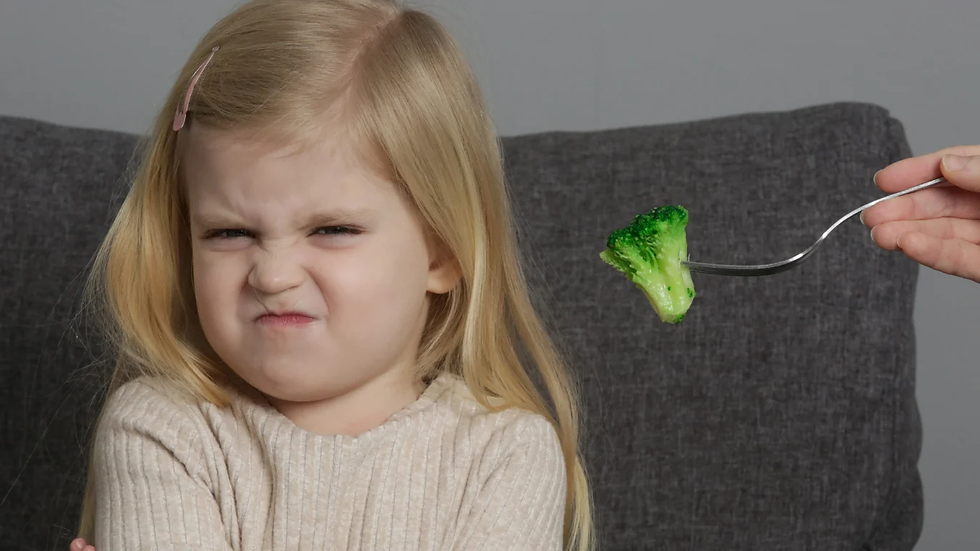
There is, of course, a quiet irony in all this. For centuries, fathers were measured by distance: how well they provided, how firmly they led, how little burden they placed on others. Today they are increasingly measured by presence: how attentively they listen, how fully they participate - not only at milestones but in the quiet, ordinary moments that make up a life. Reading bedtime stories. Attending recitals. Learning the names of friends, teachers, fictional characters, and stuffed animals whose social lives have somehow become household affairs of state. The job didn’t become smaller. It became more human. The great patriarchs of history may have commanded empires, but few ever faced the diplomatic complexity of negotiating with a five-year-old over why vegetables remain non-negotiable.
And maybe that’s why Father's Day remains such an odd little holiday. It celebrates a role that has transformed from authority into partnership, from command into companionship. The kings of households have become fellow travelers in the bewildering enterprise of raising human beings. Which may explain why so many fathers insist they do not need much in return. After all, history has steadily reduced the power of fathers while quietly increasing their importance. And there are worse to be remembered for than simply having been there.
The Quiet Evolution of Fatherhood
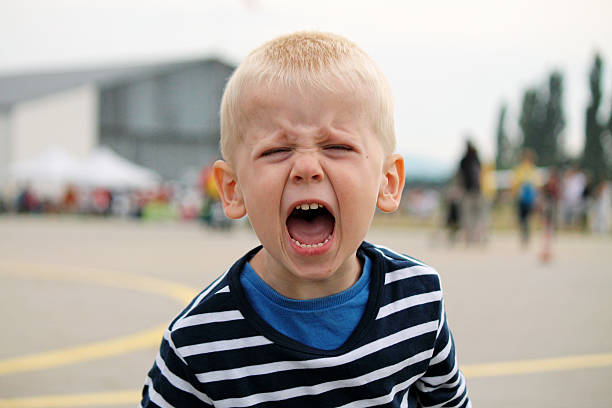
History has not been especially kind to fathers. Once they commanded households, inherited titles, and dispensed wisdom from positions of unquestioned authority. Today they negotiate bedtime with tiny constitutional lawyers who argue precedent with astonishing precision and can detect even the faintest inconsistency in parental governance. Empires have risen and fallen. Dynasties have come and gone. Yet no ruler in history ever faced an adversary quite so formidable as a four-year-old who has been told it is time to leave the playground.

But maybe this isn’t decline so much as evolution. The old patriarch measured his success by obedience; the modern father increasingly measures it by connection. Somewhere along the long march from ancient Rome to the age of video calls and streaming subscriptions, fatherhood became less about command and more about companionship. The kings of households became partners in the bewildering enterprise of raising human beings. Which, for all of history’s talk of empires and authority, may actually be the harder job.
And so, Father's Day arrives each year with its modest expectations and practical gifts: socks, tools, novelty mugs, cards hastily signed moments before lunch reservations. It was never destined to be the grandest holiday on the calendar. Fathers themselves have rarely been grand figures in the stories families tell. More often they stand quietly at the edges of memory: beside bicycles missing training wheels, in audience seats at recitals, in driveways offering advice that sounds suspiciously obvious until one day it isn't.
Maybe that’s why Father's Day endures. Not because fathers are flawless, or wise, or even particularly easy to understand. But because across cultures and centuries, in ways both large and small, they have shown up. History may remember kings, conquerors, and empires. Families, however, remember who was there when the tire went flat, the heart got broken, or the world suddenly seemed larger than it had the day before. Which, as monuments go, might not be marble. But it’s not bad.
Author’s Note: Father's Day presents a unique challenge in the annals of gift-giving. Fathers, as a species, have spent generations insisting they "don't need anything," only to react with childlike wonder upon receiving precisely the sort of item they claimed not to want.
So, for the father who has everything - or insists he does - there is The Book for Dad Who Wants Nothing: Unusual Trivia and Mind-Blowing Fun Facts for Dads Who Have Everything by Max Marble.

Because fathers possess an almost supernatural appetite for obscure facts they can deploy at dinner parties, family gatherings, or while standing beside a grill explaining how the Roman aqueduct system was, frankly, superior.
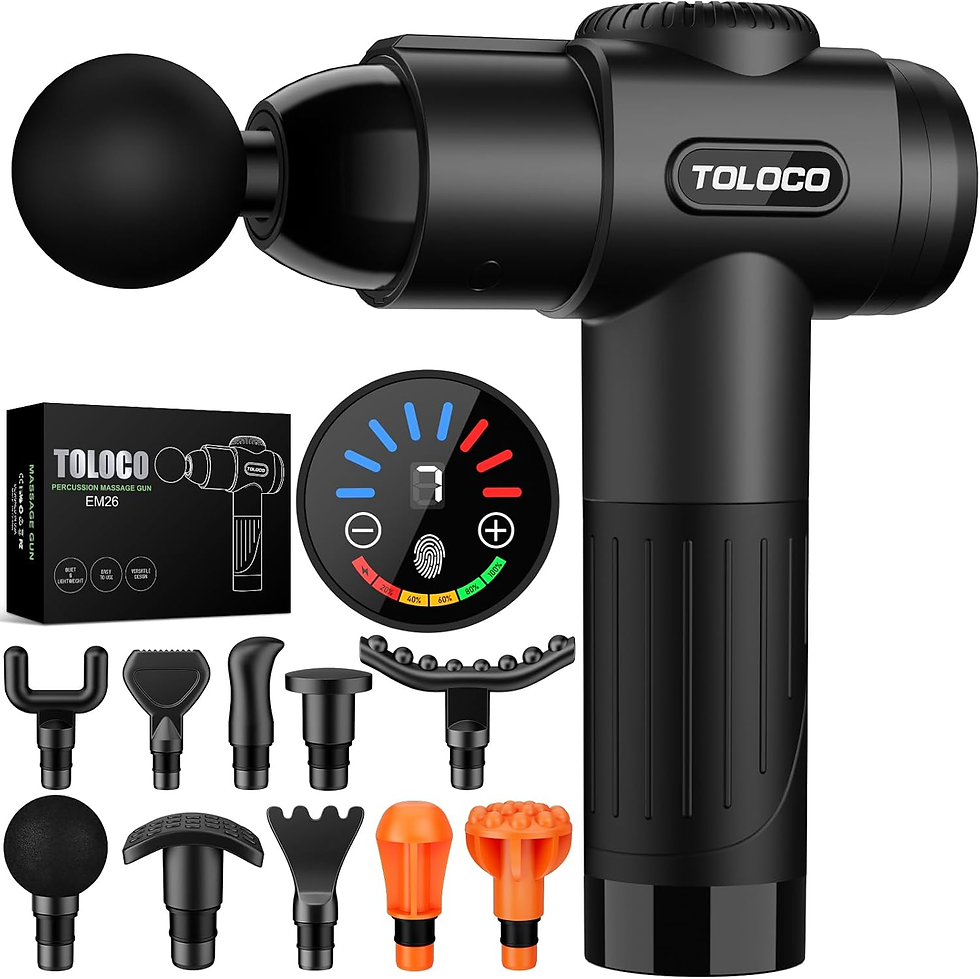
Of course, fatherhood can be hard on the machinery. For those whose shoulders have spent decades carrying groceries, assembling furniture, and demonstrating the correct way to load a dishwasher (a debate no civilization has ever truly settled), the TOLOCO Massage Gun, Deep Tissue Back Massage for Athletes for Pain Relief, Percussion Massager with 10 Massage Heads offers the sort of relief once available only to emperors, professional athletes, and people with much better posture.
And finally, for the father whose pockets function as an archaeological dig of keys, receipts, coins of uncertain origin, and charging cables that fit absolutely nothing currently owned by the household, there is the TESLYAR Wood Phone Docking Station and Organizer.
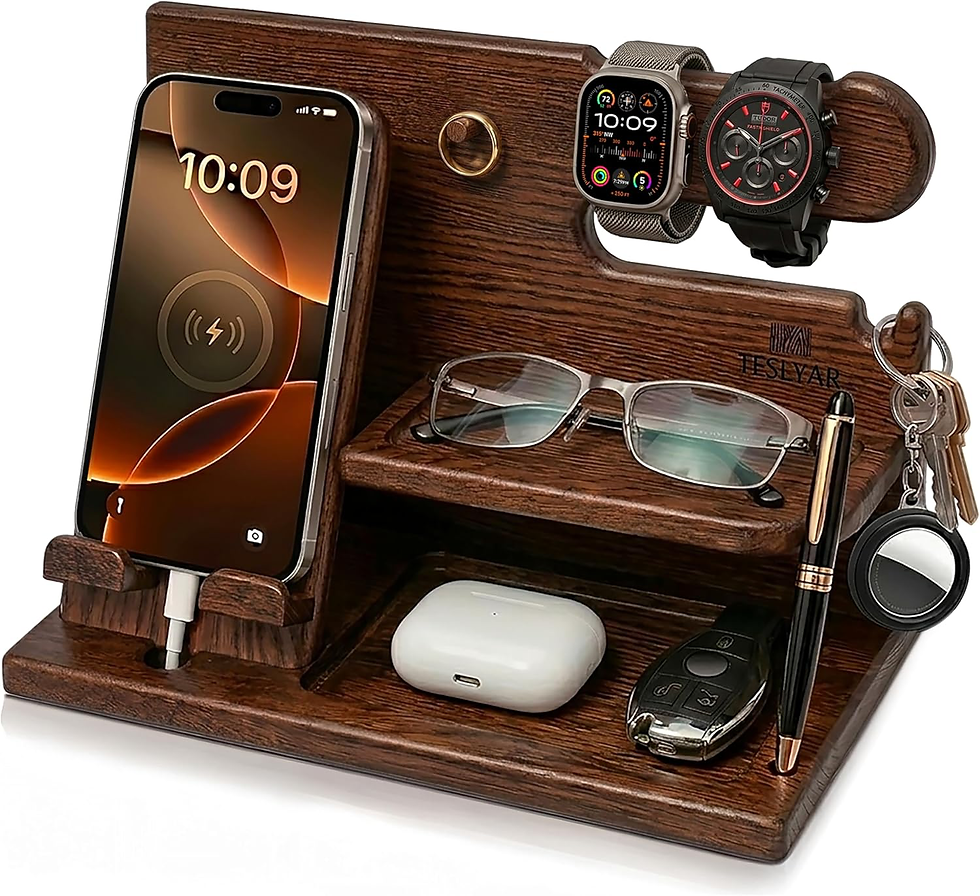
A handsome resting place for phones, wallets, watches, and other daily essentials - because after a lifetime of keeping everyone else's lives organized, perhaps Dad deserves a place to misplace his own things in style.
As always, any purchases made through these links help support the continued production of essays examining the thin and increasingly questionable line between human civilization and organized nonsense.


Nailed it! We have evolved, but only in so much as cultures have over the millennia. The pressures of knowledge have changed from ultinate decision maker, provider, protector, general appliance repairman, oil changer to all of those, except ultimate decision maker, appliance repairman and oil changer. Although I am not really sure we were ever the ultimate decision makers (appliances and cars have become too complicated for the layman to tackle).
I was and am one of those “I don’t need anything”dad’s. My favorite gifts to this day are the VHS tapes of the Little Mermaid, Snow White , Lady and the Tramp as the perfect gifts my girls gave me. And oh yes, the label maker I receiv…