
The Vegetable That Fed, Offended, and Finally Won

There are certain things polite society has spent centuries pretending not to notice. Body odor. Snoring. That one relative who believes every headline beginning with the words "Scientists Discover..." And, of course, the unmistakable aroma left behind by someone who has enthusiastically embraced an extra helping of a particular ingredient at dinner. It has a remarkable ability to clear elevators, silence first dates, and make fellow passengers suddenly remember they meant to stand somewhere else.

Which is interesting, because the same people who recoil from its lingering presence will happily pay extra to have it slow-roasted, whipped into butter, folded into aioli, infused into olive oil, or delicately scattered over something with an Italian name they can't quite pronounce. We’ve developed an extraordinary talent for objecting to the consequences while celebrating the cause. It's the culinary equivalent of applauding fireworks and complaining about the smoke.
History is littered with examples of ordinary things acquiring extraordinary reputations. A simple object becomes a symbol of wealth in one century and poverty in the next. It's hailed as medicine by one generation and dismissed as superstition by another. Somewhere along the way, people stop reacting to the thing itself and start reacting to what they imagine it says about the person holding it. Humans have always been remarkably good at seasoning reality with a generous helping of prejudice.

Which brings us to garlic, a bulb that has spent the better part of seven millennia exposing one of humanity's more endearing flaws: our astonishing ability to mistake status for wisdom. It fed the builders of pyramids, marched with soldiers, frightened imaginary monsters, offended aristocrats, survived more reinventions than most corporations, and somehow emerged as the undisputed hero of kitchens around the world. Not bad for something that spends most of its life buried in dirt.

The World's First Energy Supplement
Long before energy drinks promised to "unlock your potential" and wellness influencers began photographing themselves beside expensive jars of powdered optimism, ancient civilizations had already settled on their performance enhancer of choice. It didn't come in a sleek plastic tub or carry a scientifically questionable trademark. It came wrapped in papery skin and smelled like it had absolutely no interest in making new friends.

Ancient civilizations were already convinced garlic possessed extraordinary powers. The ancient Egyptians held garlic in surprisingly high regard. Historical records show it was regularly issued to laborers working on massive construction projects, including the pyramids, because it was believed to improve strength and endurance. In effect, garlic became prehistoric Gatorade crossed with an HR wellness program. Later historical accounts even claim that when garlic rations were interrupted, workers protested until supplies were restored. Modern employees ask for standing desks. Pyramid builders apparently demanded more garlic.

The Egyptians weren't alone. Greek athletes ate garlic before competitions, convinced it gave them an edge. Roman soldiers marched with it for much the same reason, believing the assistance of a particularly pungent bulb could bolster courage and stamina. Whether it was improving performance or simply boosting morale, one thing was beyond dispute: garlic had acquired a reputation as the edible equivalent of a motivational speech.
It's an oddly familiar story. Every age seems convinced it’s finally discovered the one miraculous ingredient capable of making ordinary people just a little more extraordinary - stronger, healthier, a little braver maybe, but somehow better than we were yesterday. Today we package those hopes in glossy tubs of powdered supplements. Four thousand years ago, they simply handed everyone another clove of garlic and got on with building pyramids.
When Smell Became a Status Symbol
Success, however, has a recurring habit of attracting critics. Somewhere between feeding pyramid builders and accompanying Roman soldiers across Europe, garlic committed a social crime from which it would spend centuries trying to recover: it became associated with ordinary people.
That was perfectly acceptable if you happened to be an ordinary person. Farmers, laborers, soldiers, sailors, and anyone whose day involved actual physical exertion continued eating garlic without much concern for what it did to their breath.

The problem arose among those fortunate enough to earn a living without lifting particularly heavy objects. To many members of the upper classes - especially in parts of later medieval and Renaissance Europe - the lingering aroma of garlic became less a culinary issue than a social one. It marked you as someone who worked rather than someone who merely supervised the workers.
The irony is, well, delicious. Here was a food celebrated for centuries because it helped sustain the people who built cities, harvested crops, fought wars, and kept civilizations running. Yet as wealth and etiquette became increasingly intertwined, garlic acquired the unfortunate reputation of being just a little too useful, too practical, and altogether too common. Apparently, smelling faintly of hard work was considerably less fashionable than smelling faintly of imported perfume.

History has repeated this trick often enough that we probably shouldn't be surprised. Give humans something genuinely useful, and sooner or later someone will decide the important question isn't whether it works, but whether the right people are using it.
From Medicine Cabinet to Monster Hunter
By the Middle Ages, garlic had undergone one of history's more remarkable career changes. Once prized as a source of strength for workers and soldiers, it increasingly found itself promoted to physician. In fairness, medieval medicine wasn't exactly overflowing with reliable treatment options. If your choices were a clove of garlic or being bled with leeches, the bulb was starting to look like the sensible member of the medical community.
Across Europe and parts of Asia, garlic became a staple of traditional remedies for everything from coughs and infections to digestive complaints and general ill health. During outbreaks of plague, many people carried or consumed garlic in the hope that it might ward off disease. One enduring legend even tells of four thieves who robbed plague victims while protecting themselves with a vinegar infused with garlic and aromatic herbs.
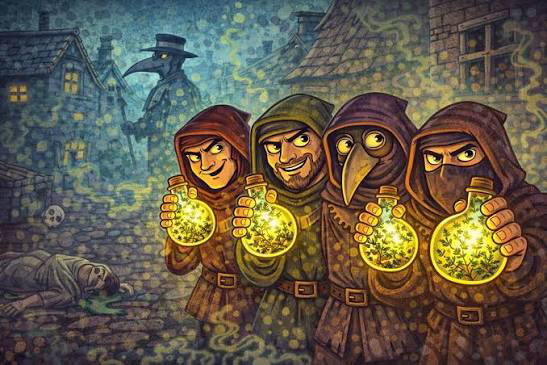
Whether the story is historical fact or not is almost beside the point. In uncertain times, people have always preferred hope with a recipe attached. Medieval pharmacies must have been wonderfully confusing places. Half apothecary. Half produce market.
Of course, once you've convinced people a humble bulb can help keep invisible diseases at bay, it isn't much of a leap to imagine it working on invisible supernatural threats as well. Garlic soon found itself hanging in doorways, tucked into pockets, and enlisted in humanity's ongoing campaign against witches, evil spirits, and, eventually, vampires. Few ingredients have ever enjoyed such a broad job description. Most foods are fortunate if they're invited to dinner. Garlic was also expected to provide home security.

The remarkable part is that history eventually gave garlic at least a partial vindication. Modern science has shown that garlic does contain compounds with genuine antimicrobial properties, even if it falls somewhat short of being an all-purpose cure or an effective vampire deterrent. Then again, vampires have been suspiciously scarce ever since people started hanging garlic over their doors. Correlation, as they say, is not causation... but if you are confronted by a vampire, it's probably one of those theories worth testing anyway.
The Bulb That Conquered the World
Most conquerors leave behind ruined cities, toppled governments, and awkward chapters in history books. Garlic chose a different strategy. It crossed borders one recipe at a time.
Believed to have originated in the rugged landscapes of Central Asia, somewhere among today's "Stan" countries, garlic began a journey that would take it farther than most emperors ever dreamed of traveling. Traders carried it east into China and India, west through Persia and the Middle East, across the Mediterranean into Greece and Rome, and eventually into nearly every corner of Europe. Even the colder reaches of northern Europe, including Scandinavia - hardly the sort of place one associates with Mediterranean flavors - eventually found room at the table for the little bulb that refused to stay home. Unlike invading armies, garlic never demanded surrender. It merely asked to be invited to dinner.

What's remarkable is not simply how far garlic traveled, but how enthusiastically each culture made it its own. Italians folded it into pasta sauces, roasted vegetables, grilled meats, and enough family recipes until garlic became less an ingredient than a member of the family. Greeks mashed it into skordalia, turning potatoes and garlic into something far greater than the sum of their parts.

Across Lebanon and the wider Middle East, cooks whipped garlic into toum, proving that with sufficient determination, a handful of cloves and olive oil could become a national treasure.

Meanwhile, throughout China, Korea, India, Thailand, and countless other Asian cuisines, garlic became so fundamental that imagining the food without it is rather like imagining Italy without Sophia Loren, or Britain without tea.
Maybe that's because garlic possesses a rare culinary gift. It doesn’t insist on being the star of the plate. Instead, it quietly persuades everything around it to become a better version of itself. Every culture changed garlic. But garlic also changed every culture it entered. For an ingredient that spends its life hidden beneath the soil, that's an astonishing amount of influence.
The Science Catches Up
If garlic had appeared for the first time today, it would almost certainly arrive in a matte black bottle with words like MAXIMUM PERFORMANCE splashed across the label. Influencers would swear it unlocked hidden reserves of energy. Podcasts would spend three hours debating its "ancient secret." Somewhere, an entrepreneur would be charging $49.95 for a month's supply of dehydrated capsules.

Instead, garlic committed the unfortunate business decision of being discovered several thousand years too early.
By the time scientists began putting garlic under the microscope, they were already several thousand years behind the rest of humanity. Farmers had grown it, cooks had perfected it, grandmothers had prescribed it, and countless civilizations had woven it into both their diets and their folklore. The laboratory wasn't introducing garlic to the world. It was merely asking whether our ancestors had been accidentally onto something.
As it turns out, they often were. Modern research has shown that garlic contains compounds with genuine antimicrobial and antioxidant properties, and studies continue to explore its potential role in areas ranging from cardiovascular health to immune function.

It's hardly the miracle cure medieval Europe imagined, but neither is it the culinary fraud some aristocrats once dismissed. Like so many things in history, the truth turned out to be less dramatic - and rather more interesting.
Maybe that's the most surprising part of garlic's seven-thousand-year journey. Garlic has survived more rebranding attempts than just about any product in history. Ancient medicine. Folk remedy. Peasant food. Ethnic cuisine. Gourmet ingredient. Superfood. Same bulb. Different marketing department.

It never lived up to the myths people created around it, yet it never deserved the scorn either. It wasn't a magical potion, a peasant's embarrassment, or an all-purpose cure. It was simply a remarkably useful ingredient that generations of people kept rediscovering for entirely different reasons. Few things expose the fragility of fashion quite like watching yesterday's embarrassment become today's delicacy.
When civilizations separated by thousands of miles and thousands of years all independently decide that something belongs in the kitchen, it's probably worth paying attention. Garlic may not have conquered disease, defeated vampires, or unlocked superhuman strength. But conquering almost every dinner table on Earth is a fairly respectable consolation prize.

The Vegetable That Fed, Offended, and Finally Won
For seven thousand years, garlic has quietly watched humanity reinvent it. We've called it medicine, peasant food, soldier's rations, protection against evil, an embarrassment, a delicacy, and, more recently, a superfood. Through all of it, the bulb itself has remained spectacularly indifferent. It never changed. We did.
Garlic's greatest achievement wasn't that it became fashionable. Fashion changes every season. Garlic simply outlasted fashion. It waited patiently while kings, doctors, priests, aristocrats, scientists, and celebrity chefs all took turns explaining what it really meant. Then it quietly went back to improving dinner.

Maybe that's why garlic has endured while so many certainties have not. Empires collapsed. Kingdoms vanished. Medical theories came and went. Fashion declared it vulgar before declaring it sophisticated. Garlic spent seven thousand years waiting for humanity to stop changing its mind.
And maybe that's the lesson here. History has always been less about discovering extraordinary things than rediscovering ordinary things we’d already dismissed. Garlic never conquered the world by demanding attention. It conquered it one meal at a time.
Authors Note: Before you head off to add an entirely reasonable amount of garlic to tonight's dinner, here are a few recommendations worthy of one of history's most overachieving vegetables.

If you've ever wondered whether there's a faster way to prepare garlic without leaving your cutting board smelling like an Italian grandmother's kitchen for the next three days, this compact electric garlic mincer is a surprisingly handy little gadget. Less chopping, less cleanup, and considerably fewer opportunities to explain why your fingers still smell like Tuesday. https://geni.us/nq4nl2

Every remarkable ingredient deserves a remarkable biography. This fascinating book traces garlic's extraordinary journey from the mountains of Central Asia to kitchens around the world, exploring the history, folklore, medicine, trade, and culture behind the little bulb that somehow became one of humanity's favorite companions. It even comes with 100 recipes. https://geni.us/7Fz0Zj

Because no discussion of garlic would be complete without at least acknowledging its legendary feud with vampires. This charming, beautifully illustrated graphic novel offers a delightfully fresh take on one of history's most famous culinary rivalries - and proves that even garlic can become an unlikely hero. https://geni.us/5QwRjV4

History may still be debating garlic's effectiveness against vampires, but there's considerably less debate about what it does for potatoes, pasta, popcorn, vegetables, grilled meats, and just about anything else fortunate enough to wander into its path. If Count Dracula does happen to stop by, consider the seasoning an added bonus. https://geni.us/N5tgZ
As always, any purchases made through these links help support the continued production of essays examining the thin and increasingly questionable line between human civilization and organized nonsense.



Garlic
I have a love hate relationship with Garlic….. a tinsy winsy bit of garlic is perfect, any more than that and it’s overpowering. Everyone else in my family can’t get enough! Can’t handle that!
Embarrassingly, I hung a strand of garlic when I was a kid (14) after watching the exorcist. I slept with a garlic strand, 5 bibles and 6 crosses all around me…. For a week.
We lived 45 minutes to the nearest movie theater, so mom and dad did not know that was the plan until that night and my set up. As good god fearing Catholics, they were not very happy.
Of course my dad didn’t help by scratching on the window screens, and poundin…