
What Our Favorite Monsters Say About Us

There was a time when becoming a movie monster was a respectable career choice. You could wear a cape, live in a castle, terrify an unsuspecting village every few years, and count on Hollywood to keep you employed for decades. Dracula had remarkable job security. Frankenstein's monster was practically unionized. Even the occasional mummy could expect to rise from the dead whenever ticket sales dipped.
Of course, like every profession, the industry changed. Vampires eventually found themselves competing with giant radioactive reptiles, possessed children, masked killers, haunted videotapes, and - more recently - artificial intelligence that somehow manages to be creepier than artificial intelligence already is. The turnover has been astonishing. Somewhere, a werewolf is probably wondering why nobody returns his calls anymore.

At first glance, it looks like Hollywood simply has a short attention span. Audiences get bored, studios chase trends, and every few years a new nightmare arrives to replace the old one. That's the easy explanation, anyway. It's comforting to think monsters come and go because filmmakers run out of ideas.
But monsters don't really evolve. People do. Every generation quietly appoints a new creature to represent whatever keeps it awake at night, and if you line up a century's worth of horror movies, you don't just get a history of cinema. You get an unexpectedly revealing autobiography of humanity - written one scream at a time.

The 1930s: We Feared the Unknown
Long before we worried about hackers, algorithms, or whether our phones were secretly listening to us, humanity had a much simpler concern: there were still enormous parts of the world we didn't fully understand. Information traveled slowly, international travel was a luxury for most people, and entire cultures could remain mysterious simply because they were an ocean away. The unknown wasn't just an idea - it was a place on the map.
The 1930s gave us no shortage of unforgettable monsters. Frankenstein's monster warned of science pushing beyond its limits, while the Wolf Man reminded us that maybe the beast we feared most wasn't always outside ourselves.

But if one character captured the era's fascination with the mysterious and unknowable, it was Dracula.

Yes, he was a vampire. But that wasn't really the point. Dracula arrived from a distant corner of Europe wrapped in folklore, superstition, and the unsettling feeling that the old world still held secrets the modern one couldn't explain. His castle sat shrouded in fog. He appeared only after dark. He obeyed rules that science couldn't measure and reason couldn't negotiate. He represented the uncomfortable possibility that, despite all our progress, there were still things lurking just beyond the reach of understanding.
That's why Dracula endured. He wasn't merely a monster with an unfortunate dental condition; he was a symbol of humanity's oldest fear - that somewhere beyond the edge of the lantern's glow, something existed that didn't care how civilized or educated we believed ourselves to be.

Today, we can explore castles on Google Street View, translate foreign languages with a tap, and watch live video from almost anywhere on Earth. The map has become smaller, the shadows a little shorter, and many of the mysteries that once haunted our imagination have quietly disappeared. Which, as it turns out, simply meant we needed to find something new to fear.
The 1950s: We Feared Our Own Brilliance
The world had entered an age where humanity could split the atom, reach for the stars, and, if things went especially badly, erase entire cities before lunch. Scientific progress had become both exhilarating and terrifying. For the first time, our greatest threat no longer seemed to lurk in some distant castle - it might be sitting inside a laboratory. And Hollywood noticed.
The decade produced no shortage of oversized nightmares. Giant ants marched across the desert in Them!,

alien visitors questioned whether humanity deserved to survive, and creatures of every imaginable variety suddenly found themselves several stories taller than nature had intended.

Apparently, exposure to radiation's most common side effect was an immediate and dramatic growth spurt.
But no monster captured the era's anxiety better than Godzilla.

Emerging from the aftermath of the atomic age, he wasn't simply a giant reptile stomping through a city. He was the physical embodiment of scientific power unleashed without fully understanding the consequences. Godzilla wasn't evil in the traditional sense. He was indifferent. Like radiation itself, he destroyed without malice, reminding audiences that nature - and our own inventions - didn't need bad intentions to produce catastrophic results.
It was a remarkable shift from the previous generation's fears. We were no longer looking over our shoulders for ancient curses hidden in forgotten castles. Instead, we were staring into microscopes, peering inside reactors, and wondering whether humanity's greatest achievement might also become its greatest mistake. The unknown hadn't vanished. We'd simply given our fears a new address: the laboratory.

The 1970s: We Feared Losing Control
The modern world had delivered remarkable progress, but it had also become increasingly uncertain. Institutions that once seemed unshakable were being questioned, social norms were changing, and many people found themselves wondering whether the things they had always relied upon were as dependable as they once believed. Fear no longer came solely from the outside world. Increasingly, it came from within.
The decade produced a remarkable collection of unsettling stories. Carrie reminded us that ordinary people could harbor extraordinary darkness,

while Jaws turned a day at the beach into an exercise in paranoia.

But no film captured the era's unease more completely than The Exorcist.
At its heart, The Exorcist isn't simply about demonic possession. It's about watching someone you love become someone you no longer recognize - and realizing there's nothing you can do to stop it.
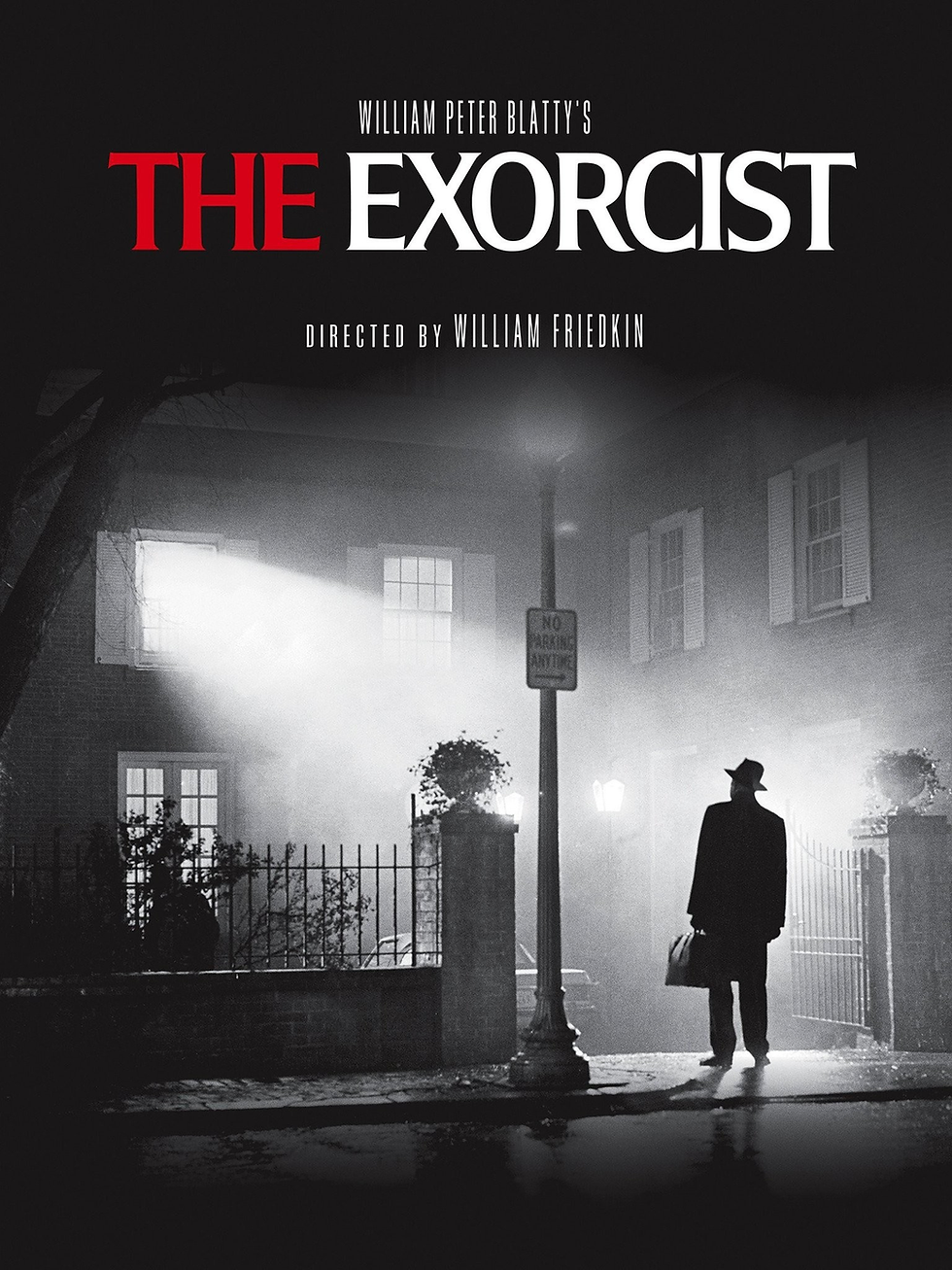
Whether audiences interpreted that through religion, psychology, illness, or something beyond explanation, the underlying fear was the same: the terrifying possibility that control is far more fragile than we'd like to believe. Sometimes the greatest horror isn't that evil exists. It's that we may be powerless to stop it.
By the end of the 1970s, our fears had changed address once again. They no longer lived in distant castles or hidden laboratories. They had moved into our homes, our families, and perhaps most unsettling of all, into ourselves.
The 1980s: We Feared That Nowhere Was Safe
By the 1980s, horror had become remarkably efficient. Earlier monsters required gloomy castles, abandoned laboratories, or at the very least an ancient curse. The new generation of villains needed almost nothing. A quiet suburban street would do nicely. A summer camp worked even better. One particularly ambitious fellow didn't even require you to leave the house. He simply waited until you fell asleep.
The decade introduced audiences to an unforgettable lineup of killers. In Friday the 13th, Jason Voorhees made camping seem like an unnecessary risk.

In Child’s Play, Chucky suggested children should be more selective about their toys,

while Hellraiser’s Pinhead proved that solving mysterious puzzle boxes was generally a poor recreational activity.

But Freddy Krueger, in A Nightmare on Elm Street, stood apart from the rest. Unlike so many monsters before him, Freddy didn't wait for you to wander into his world. He came looking for you in yours.

Freddy didn't chase his victims through dark forests or haunted mansions. He met them in the one place every human being has to visit eventually: sleep. You could lock every door, turn on every light, and move to another city, but sooner or later you'd have to close your eyes. It was an elegantly unfair advantage. In retrospect, Freddy may have been history's first monster to weaponize basic human biology.
The monsters of the 1980s weren't frightening because they came from another world. They were frightening because they invaded ordinary life. Fear no longer waited at the edge of civilization or inside a secret laboratory. It was waiting in your neighborhood...and occasionally in your dreams.

The 1990s: We Feared That We Already Knew the Story
By the 1990s, horror audiences had become experienced travelers. We'd spent decades wandering haunted castles, fleeing masked killers, surviving possessed children, and learning that accepting mysterious invitations was almost never in our best interest. We knew that splitting up was a bad idea, the creepy basement should be avoided, and that anyone saying "I'll be right back" was practically signing their own death warrant. We knew the rules now. Or at least we thought we did.
The decade still introduced memorable nightmares. Candyman turned an old urban legend into something far more unsettling…and bloody,

while The Blair Witch Project proved that sometimes what you don't see is infinitely scarier than what you do.

But it was Ghostface, the masked killer from Scream, who perfectly captured the mood of the era.
Ghostface wasn't terrifying because he was unstoppable. Quite the opposite. He was surprisingly ordinary. What made him dangerous was that he understood horror movies just as well as the audience did. He knew the cliches, expected the predictable reactions, and cheerfully exploited both.

It was a clever twist that acknowledged something new: after nearly a century of horror films, the monsters had realized we'd been studying them. To keep frightening us, they had to reflect the ways we'd changed.
Fear had a new address yet again. It no longer depended on the unknown, scientific catastrophe, or even supernatural evil. Instead, it came from the unsettling realization that knowing the rules doesn't guarantee survival. Sometimes the monster has seen the same movies you have.
The 2000s: We Feared the World We'd Connected
The new millennium promised a future unlike any before it. The internet erased distance, mobile phones became constant companions, and technology connected us in ways previous generations could hardly imagine. But every great innovation comes with an uncomfortable question: what else have we just invited into our lives?
Horror adapted almost immediately. Paranormal Activity suggested that even the safety of home could be quietly observed,

while found-footage films blurred the line between fiction and reality by making audiences feel as though they were watching something they were never meant to see. But it was Samara from The Ring who became one of the decade's defining monsters.

Samara didn't need a haunted castle or a dark forest. She traveled through technology itself. A videotape became the doorway, turning an ordinary object into something sinister. Today, the idea of a cursed VHS cassette may seem almost quaint, but the fear behind it has only grown more relevant. We increasingly live our lives through screens, trusting them with our memories, our conversations, and our identities. The Ring hinted at a future where danger no longer had to knock on the front door. We were perfectly capable of inviting it in ourselves.

Our fears had changed address yet again. They no longer lived in laboratories or suburban neighborhoods. They now traveled effortlessly through the very networks we'd built to bring the world closer together.
The 2020s: Today We Fear Our Own Reflection
Today's monsters don't always wear masks, hide under beds, or wait in abandoned houses. Increasingly, they arrive through algorithms, artificial intelligence, social media, and technologies we created to make life easier, faster, and more connected. For the first time in horror's long history, the monster often doesn't look like a monster at all.
Modern films have embraced this shift. Whether it's M3GAN turning artificial intelligence into an unsettling companion,

Afraid exploring what happens when we willingly hand over our homes and families to AI,

or countless stories built around digital surveillance, identity, and manipulation, today's horror asks a very different question than Dracula ever did. It's no longer, "What's lurking out there?" It's, "What have we built...and do we still control it?"
Perhaps that's why modern horror feels so different. The most unsettling villains are rarely supernatural anymore. They are recommendations we didn't ask for, voices that sound convincingly human, faces that never existed, and systems making decisions few people fully understand. Earlier monsters wanted our blood, our souls, or our lives. Today's monsters are just as interested in our data, our attention, and our trust. Somehow, that’s even scarier.

Looking back across a century of horror, the pattern becomes surprisingly clear. Every generation gave its fears a different face. But today's fears are harder to recognize because they often wear our own reflection. The monster never disappeared. It simply learned to look a little more like us.
What Our Favorite Monsters Say About Us
Looking back, it's tempting to think horror movies have spent the last century inventing increasingly imaginative monsters. But perhaps they've been doing something far more interesting. They've been quietly documenting us. Every vampire, giant reptile, possessed child, dream-stalking killer, and digital nightmare has simply reflected whatever happened to keep humanity awake at night.
The monsters changed because we changed. When the world felt vast and mysterious, we feared the unknown. When science began rewriting the rules of nature, we feared our own brilliance. When certainty gave way to doubt, we feared losing control. As our neighborhoods, our technology, and eventually our own creations became more complicated, our monsters faithfully followed. They never led the way. They simply moved into whatever address our fears had most recently occupied.
That's why the old monsters never really disappear. Dracula still appears on our screens. Godzilla still levels cities. Freddy still invades dreams. They remain with us not because they continue to represent our greatest fears, but because they remind us of who we once were. Every generation inherits the monsters of the last, then quietly creates a few new ones of its own.

Maybe that's the real purpose of horror. Not to teach us what lurks in the darkness, but to reveal what already lives inside us. Because monsters don't evolve. People do. And if future generations ever want to understand us, they probably won't need to read our history books. Our movie monsters will tell them everything they need to know.
Authors Note: If this short tour through humanity's changing nightmares has inspired you to revisit the world of horror, we've got a few items that seemed appropriate to the occasion. Whether you're looking to understand why monsters evolve (even if they technically don't) or simply want to make your next movie night a little more atmospheric, these should do nicely.
📖 Danse Macabre by Stephen King. If today's article was the appetizer, this is the full-course meal. King doesn't just discuss horror movies - he explores why they work, what they reveal about us, and why every generation invents new ways to lose sleep. It's thoughtful, funny, insightful, and almost certainly proof that Stephen King has spent far more time thinking about monsters than is probably healthy.

🎬 Horror Movie Scratch-Off Poster. Think of this as your official Monster Bucket List. One hundred iconic horror films, each waiting to be scratched off after you've watched it. It's a fun way to discover forgotten classics, settle long-running debates about what actually counts as "essential viewing," and occasionally wonder what “possessed” someone to make that movie.

🍿 Retro Popcorn Holders. If you're going to spend two hours watching people make catastrophically bad decisions in abandoned cabins, creepy basements, or suspiciously affordable houses, you deserve proper popcorn. These retro-style holders add just the right amount of old-school movie theater nostalgia to the evening - and they're considerably less likely to be cursed than a mysterious videotape.

🏮 Vintage Oil Lantern. Every horror story begins with someone wandering just a little too far beyond the light. Fortunately, you don't have to. This vintage-style lantern won't keep vampires away, but it will remind you just how small a circle of light really is - and why humanity has spent thousands of years imagining what might be waiting just beyond it. It's atmospheric, practical, and significantly more reassuring than relying on your phone's flashlight when the power goes out.

As always, any purchases made through these links help support the continued production of essays examining the thin and increasingly questionable line between human civilization and organized nonsense.


My favorite sci-fi/horror was defintely the 50’s! The rise of McCarthyism, led to more horrifying fears, the rise of creatures from the atomic bomb and you left out aliens from other planets!
Them, invasion of the body snatchers, the thing from another planet,the day the earth stood still, the beast from 20,000 fathoms, the blob, the house of was, it came from outer space, the creature from the black lagoon, Godzilla, King Kong….. whew just to name a few .
You write an entire series on the 50’s sci-fi . I know the younger people will say bad animation, compared to today’s AI, CGI, etc….. but if you think back to Godzilla. They use claymation! You know how ha…