
It Started with a Ball

The World Cup has ended now, which means billions of people have reluctantly returned to trying to remember they care about things like quarterly reports, grocery shopping, and answering emails. For a few glorious weeks, entire nations suspended ordinary life in favor of watching twenty-two people chase a ball around a field while commentators spoke with the urgency usually reserved for natural disasters. Perfectly sensible adults yelled at televisions. Strangers hugged in airports. Sleep schedules dissolved across time zones. Civilization, hard as it may be to believe, for once agreed on something.

Humans have always been remarkably talented at turning simple ideas into elaborate spectacles. Give us a game, and we transform it into something far larger than the game itself. We paint our faces, drape ourselves in flags, memorize statistics that have absolutely no practical value, and develop fierce opinions about referees we've never met. The ball may travel in predictable directions. Human emotions rarely do. If another species were observing us from a comfortable distance, they'd probably conclude that kicking leather between two posts held profound spiritual significance.

Maybe that's because competition has never really been about winning. Sure, winning is important. But the real attraction is belonging to the story - to feeling, if only for ninety minutes, that your hopes are tied to the graceful left foot of a complete stranger from a city you've never visited. Sports have always offered us permission to become irrational together, and we seem remarkably grateful for the opportunity.
Of course, modern football is also evidence that humanity has mellowed considerably. The World Cup may have just crowned the best football team on Earth. But compared to some of the sports our ancestors invented, today's players have it easy. No one's expected to outrun a charging bull, wrestle an alligator, or win a match and immediately become a religious sacrifice. Compared with the sports that entertained ancient civilizations, the World Cup is less the pinnacle of athletic competition than proof that, somewhere along the way, common sense finally managed to make the team.

History didn't invent these games in the order you are about to read them, but viewed together they reveal an unmistakable pattern: whenever humans came up with a perfectly good pastime, someone inevitably asked, 'How can we make this considerably more dangerous?'
Long Before FIFA
If you're going to invent a sport, a ball seems like a perfectly reasonable place to start. It's round, it rolls, and it gives otherwise sensible adults something to chase with remarkable enthusiasm. Thousands of years before packed stadiums echoed with football chants, the civilizations of Mesoamerica were already gathering to watch athletes compete in a game centered around a solid rubber ball. At first glance, it feels comfortingly familiar.

Then the details begin to emerge.
Players weren't allowed to use their hands or feet, relying instead on their hips, shoulders, and elbows to keep a ball - one that could weigh several kilograms - in motion through a stone court. Archaeologists have uncovered well over a thousand ball courts across present-day Mexico and Central America, suggesting the game wasn't a curiosity. It was woven into everyday life for centuries. Mythologist Joseph Campbell, in The Power of Myth, even described it as a spiritual ancestor of modern basketball, noting the elevated stone hoops that players struggled to send the ball through without the benefit of hands.

And then there was the small matter of what happened after the final whistle.
Campbell famously recounted that the captain of the victorious team was offered as a sacrifice to the gods - the ultimate reward for playing a game well. Many modern archaeologists believe the story was probably more complicated than that, with different cities and cultures following different rituals, and historians are still debating exactly who, if anyone, earned that particular post-match honor. Either way, it's one more reminder that while today's athletes celebrate by hoisting a trophy and spraying champagne, ancient fans occasionally had rather different ideas about what it meant to have a winning season.
Then Someone Added Weapons
Apparently, somewhere along the line, someone decided that chasing a ball simply wasn't exciting enough. A horse seemed like an obvious improvement. A twelve-foot lance? Even better. Thus, was born jousting, a sport that answered a question no one had previously thought to ask: "What if two heavily armored people galloped toward each other at full speed and hoped for the best?"

To be fair, medieval knights didn't see it as madness. Tournaments were grand public spectacles that blended military training with entertainment. A successful jouster needed extraordinary balance, strength, timing, and courage. Crowds gathered to cheer their favorites, nobles wagered on the outcomes, and champions earned fame that spread far beyond their own kingdoms. In many ways, it wasn't so different from today's biggest sporting events, where elite athletes become celebrities and spectators happily spend small fortunes for the privilege of watching them compete.
The difference, of course, was that today's equestrian competitions generally frown upon impaling the opposition.

That wasn't always the case. Jousting carried very real consequences, sometimes extending well beyond the tournament grounds. In 1559, King Henry II of France suffered a lance splinter through his visor during a celebratory joust.

He died ten days later, triggering political changes that rippled across Europe. Historians also believe a devastating jousting accident suffered by England's Henry VIII may have contributed to the dramatic personality changes for which he later became infamous. Modern athletes occasionally make history. Medieval athletes occasionally rewrote it by accident.
Because Apparently Bulls Needed to Be Involved
Every civilization seems to have had its own idea of athletic excellence. For the ancient Minoans of Crete, that standard involved a charging bull and an extraordinary amount of optimism. More than 3,500 years ago, they looked at one of nature's most powerful animals and decided the best way to demonstrate courage, skill, and possibly a questionable relationship with personal safety was to run directly toward it.
Known today as bull leaping, the practice was part athletic competition, part religious ceremony, and part public spectacle. Frescoes discovered at the Palace of Knossos depict athletes charging toward a full-grown bull, grabbing its horns, using the animal's momentum to vault over its back, and - if everything went according to plan - landing gracefully on the other side.
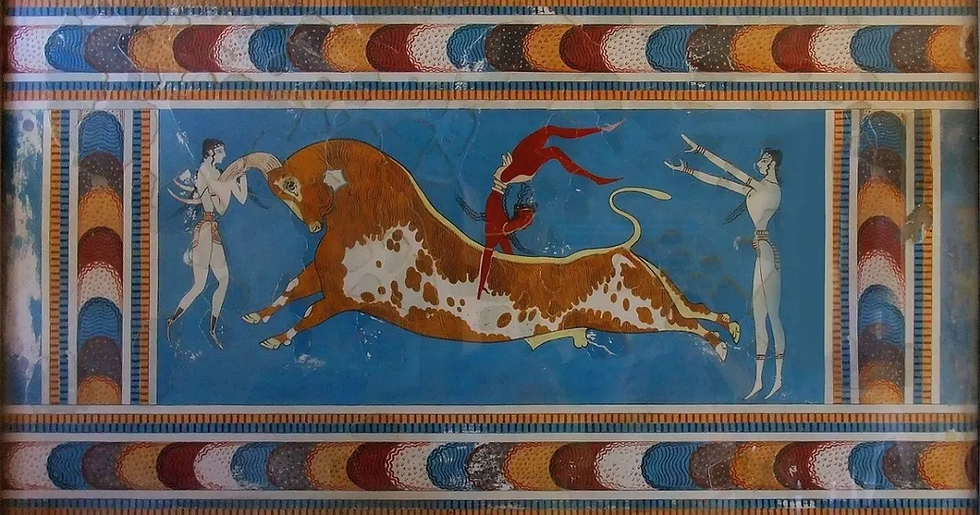
It was equal parts athletic event, religious ritual, and spectacular public entertainment. It also required a level of confidence most of us struggle to summon while parallel parking.
The closest modern comparison is probably gymnastics, although somewhere along history's timeline a very sensible person decided that livestock was an unnecessary complication. Today's gymnasts still amaze us with impossible flips, flawless balance, and gravity-defying routines. They simply perform on spring floors and balance beams instead of hoping a two-thousand-pound animal remains committed to the choreography.
Looking back, the truly remarkable part isn't that bull leaping existed. Humans have always been fascinated by testing their limits. The fascinating part is that at some point, someone must have said, "I've got a new sport. Picture gymnastics... but the equipment has horns and occasionally tries to kill you."

An entire society watched someone attempt this, decided it represented excellence, and then built places for other people to gather and watch. The Minoans didn't just create a sport. They created one of history's first extreme athletics events - long before anyone thought to add sponsorships, slow-motion replays, or a commentator saying, "This may not end well."
When "Full Contact" Meant Exactly That
Every civilization seemed to have one sport that perfectly reflected its personality. The ancient Greeks gave the world philosophy, democracy, and the Olympic Games. They also gave us pankration, a contest that combined the punches of boxing with the grappling of wrestling and then removed nearly every rule that might have made either activity feel reassuring. It proved that even the civilization responsible for Socrates occasionally looked at two people fighting and thought, "This could use fewer rules."

Introduced into the ancient Olympic Games in 648 BC, pankration was regarded as one of the ultimate tests of physical excellence. Fighters punched, kicked, threw, choked, locked joints, and generally employed whatever techniques they thought would persuade their opponent to reconsider their life choices. Officially, only biting and eye-gouging were forbidden, although historical accounts suggest those rules occasionally enjoyed the same flexible interpretation that modern sports fans sometimes attribute to referees.
If all of this sounds familiar, it's because it is. Modern mixed martial arts owes a considerable debt to pankration. Today's UFC athletes still combine multiple fighting disciplines into a single contest, demanding extraordinary conditioning, discipline, and technical skill. The difference is that now there are weight classes, timed rounds, medical examinations, referees empowered to stop a fight, and enough regulations to fill a small library. The ancient Greeks, by comparison, seemed content with a quick reminder not to bite anyone.

Maybe that's progress. After all, modern audiences still enjoy watching elite athletes push themselves to astonishing physical limits. We've simply reached a point where we'd prefer everyone involved to leave the arena under their own power. By ancient standards, that probably makes today's combat sports look almost disappointingly civilized.
Gravity Has Always Been Undefeated
Not every civilization believed a great sport required an opponent. The ancient Hawaiians looked at steep volcanic hillsides and concluded that gravity was challenge enough. Their sport of choice was hōlua sledding (HOH-loo-ah), a breathtaking combination of speed, courage, and what most insurance companies would politely describe as poor decision-making.
Competitors raced downhill on narrow wooden sleds, sometimes traveling hundreds of feet over carefully constructed stone tracks that crossed rugged volcanic terrain.

The sport was especially popular among Hawaiian chiefs, who viewed it as both recreation and a demonstration of skill. Staying upright demanded remarkable balance and nerves of steel. Failing to stay upright introduced participants to the rather unforgiving realities of lava rock.
Modern winter sports feel like distant cousins. Downhill skiing, luge, skeleton, and bobsled all celebrate the same exhilarating partnership between speed and gravity. The crucial difference is that today's athletes generally race over smooth ice or carefully groomed snow while wrapped in protective equipment designed by engineers who have spent decades trying to reduce the likelihood of serious injury.

Ancient Hawaiians, by comparison, seem to have regarded the mountain itself as part of the examination.
Maybe that's always been the appeal of sports. Sometimes the opponent isn't another team or another athlete. Sometimes it's fear itself. Of course, choosing to confront that fear by launching yourself down the side of a volcano still feels like a wonderfully ambitious way to spend a Saturday afternoon.
Not Every Game Needs a Ball
Not every civilization looked at a field and imagined a ball. Across the vast steppes of Central Asia, where horsemanship meant survival as much as transportation, athletic competition naturally evolved on horseback. The only real surprise is what the players chose to carry.
The sport is called Buzkashi, and it has been played for centuries in countries such as Afghanistan, Kazakhstan, Kyrgyzstan, Tajikistan, and Uzbekistan. Instead of using a ball, riders compete to seize control of a headless goat carcass, wrestling it away from dozens of other horsemen before carrying it across the field to a designated scoring area.

Success demands exceptional riding ability, remarkable upper-body strength, and the willingness to be jostled by a thundering pack of competitors who are every bit as determined as you are.
Odd as it sounds, the strategy would feel familiar to anyone who has watched polo, rugby, or even football. Gain possession. Protect it under relentless pressure. Advance toward the scoring area before your opponent stops you. The strategy is sophisticated, the athleticism undeniable, and the competition every bit as fierce as any championship match played in a modern stadium.
Only the equipment manager took a very different approach – which made the commemorative merchandise department’s job considerably more difficult.

Even so, Buzkashi serves as a useful reminder that the world's sporting traditions have never followed a single rulebook. They reflect the landscapes, cultures, and histories that created them, and, on occasion, leave the rest of us quietly thankful that somebody, somewhere, eventually decided an inflated leather ball was good enough.
Because Even Water Needed a Competitive Upgrade
Humans have never been particularly good at leaving useful inventions alone. Boats were created to transport people, explore new lands, and make fishing considerably easier. Naturally, someone eventually looked at one and thought, "Yes, but what if we could also use this to knock another person into a river?"
Ancient Egyptians had an answer in the form of water jousting, a competition in which teams of fishermen battled from small boats using long poles to push opponents into the Nile.

Unlike modern rowing competitions, where victory comes from speed and coordination, success here depended on balance, strength, and the ability to remain upright while someone actively tried to remove that option. It was part sport, part spectacle, and part reminder that ancient Egyptians had a very different definition of a relaxing afternoon on the water.
The closest modern comparisons might be rowing, canoe polo, or other competitive water sports where teamwork, strategy, and physical skill determine the winner. The difference is that today's athletes generally focus on moving their boat faster than everyone else.

Ancient competitors had the added objective of making sure someone else ended up swimming.
What makes these forgotten sports fascinating is how familiar they often feel beneath the strange details. The equipment changes. The rules evolve. The dangers become slightly more manageable. But the basic human instinct remains the same: gather people together, create a challenge, and see who can master it better than everyone else.
Eventually, Someone Challenged an Alligator
Every civilization has measured courage in its own way. Some raced downhill on volcanic slopes. Others vaulted over charging bulls or climbed onto horses carrying long wooden lances. But eventually, humanity arrived at a question that almost feels inevitable: "What if the opponent had several dozen razor-sharp teeth?"
Among the Seminole and Miccosukee peoples of what is now the southeastern United States, alligator wrestling developed from practical knowledge rather than a search for entertainment. Understanding how to handle these powerful reptiles was a valuable survival skill, one that later evolved into public demonstrations of confidence, technique, and remarkable composure. It demanded far more than bravery. Success depended on reading an animal's behavior, reacting with precision, and respecting just how quickly things could go wrong.

There isn't really a modern sporting equivalent. You could argue that it shares something with wrestling, martial arts, or even rodeo, but none of those require your opponent to have a bite force capable of crushing bone. At some point, organized sport quietly reached the sensible conclusion that athletes should compete against one another instead of an apex predator.
Maybe that's the real story hidden inside all of these ancient games. They weren't created because our ancestors were reckless. They reflected the places people lived, the animals they encountered, the skills they valued, and the challenges they faced every day. What seems absurd to us often made perfect sense to them.

Still... after traveling through thousands of years of humanity's sporting imagination, it's hard not to appreciate just how revolutionary one simple idea turned out to be - an inflated leather ball. It may not have been the most exciting invention in history. But it was most certainly safer than most of the other options.
It Started with a Ball
Somewhere, thousands of years ago, someone picked up a ball and challenged another person to a game. It was a wonderfully simple idea. Of course, being human, we couldn't leave it alone. We added horses, bulls, boats, volcanoes, goats, and the occasional alligator. We created trophies, traditions, rivalries, and enough rules to keep generations of referees gainfully employed. Yet beneath all the spectacle, the objective has remained remarkably unchanged. Find a challenge. Test yourself. See who comes out smiling.

Maybe that's why the World Cup captivates billions of people the way it does. Strip away the television cameras, sponsorship logos, instant replays, and social media debates, and it's still just a game. For ninety minutes, strangers become teammates, neighbors become rivals, and entire countries agree to care deeply about the journey of a single ball. The technology is new. The emotions are ancient.
The sports may have changed, but we really haven't. We still admire courage. We still celebrate skill. We still gather in crowds to cheer impossible moments and convince ourselves that, this time, the outcome somehow matters a little more than the last. Whether the arena is a stone court in Mesoamerica, a palace in Crete, a dusty field in Central Asia, or a gleaming stadium filled with eighty thousand cheering fans, the game has always been an excuse to tell ourselves the same story: that ordinary people are capable of extraordinary things.

Which, when you think about it, is probably the greatest sporting tradition of all. Not the charging bulls or the wooden lances. Not the volcanoes or the alligators. Just the wonderfully stubborn belief that tomorrow someone, somewhere, will invent another game, another competition, another reason for complete strangers to gather together and cheer. Let's just hope it involves an inflated leather ball.
Authors Note:
If this journey through humanity's long history of questionable sporting decisions left you feeling strangely nostalgic for simpler times, we've found a few items that seemed entirely appropriate.

After writing 3,000 words about humanity's obsession with balls, it felt only appropriate to recommend one that can hold coffee. Consider it a small tribute to the invention that eventually convinced us to stop involving bulls, volcanoes, and alligators.
☕ Check them out here: https://geni.us/HoaDFSO
📖 The Power of Myth – Joseph Campbell with Bill Moyers

Campbell's discussion of the ancient Mesoamerican ballgame remains one of the most fascinating explorations of how sport, ritual, and mythology became intertwined. If today's article sparked your curiosity about the deeper stories behind humanity's oldest traditions, this classic belongs on your bookshelf.
📚 Find it here: https://geni.us/BJr2P

Not every ancient sporting tradition deserves a modern revival. Fortunately, this is about as close as most of us need to get to an alligator. It's considerably more relaxing, significantly less bitey, and requires no survival skills whatsoever.
🏖️ Float safely here: https://geni.us/ENkM
As always, any purchases made through these links help support the continued production of essays examining the thin and increasingly questionable line between human civilization and organized nonsense.



Okay so this took a weird turn. Likening jumping bulls to gymnastics so perfect because balancing on a 4 inch beam and then hurling your body into the air, flipping and then landing back on this tiny beam is truly insane. Gymnasts are incredible athletes and deserve way more of our adulation than we give them.
I mean jousting is somewhat insane, but going back jumping bulls. That is not insane, people that did that I am sure were in asylums and convinced this was a good idea!
But the most bizarre, and the one that intrigued me most was Buskashi: carrying around a headless goat!?!?!?! I mean seriously, so we are lying around one day, maybe having a bee…