
What’s in a Name? Usually a Dead Guy.
- tripping8
- Apr 24
- 11 min read

There’s a particular kind of confidence required to believe one’s name will endure. Not merely remembered - anyone with a decent obituary can manage that - but used. Spoken daily by strangers who would neither recognize your face nor care to, invoked casually over lunch or in passing conversation, stripped of biography and pressed into service as something altogether more practical. It’s an odd afterlife, less marble statue and more household utility.

Language is an efficient undertaker. It sands down the inconvenient edges of history, folds entire lives into syllables, and tucks them neatly into sentences where they can do some small, repetitive work. The result is a lexicon that feels organic, inevitable even, as though these words simply arrived fully formed - like mushrooms after rain - rather than as the remnants of people who once had opinions, ambitions, and, in many cases, deeply questionable judgment.
And yet, every so often, a name lingers with just enough shape to suggest something was there once. A faint outline of a person who, through accident or insistence or just sheer bad luck, managed to attach themselves to an object, a habit, or an idea. Not always for noble reasons. Not always intentionally. Occasionally in ways that might, had they been consulted, feel less like an honor and more like a clerical error with remarkable staying power.

Which brings us to the quiet realization that many of the things we use, eat, wear, or casually reference were not named for what they are, but for who someone happened to be - turning language into a kind of polite graveyard where the headstones have been repurposed into everyday speech, and the deceased continue on, not in memory, but in function.
The Accidental Legends
There’s a comforting kind of immortality reserved for those who didn’t appear to be trying very hard. No grand theories, no sweeping reforms - just a well-timed decision, a minor convenience, or the sort of improvisation one makes when guests arrive and expectations are low. History, in these cases, behaves less like a judge and more like an inattentive maître d’, handing out permanence to whoever happened to be standing closest to the door.
Take the sandwich, which owes its existence to John Montagu, 4th Earl of Sandwich, a man who achieved culinary legacy not through inspiration, but through refusal. In mid-18th century Enlightenment-era England, faced with the inconvenience of pausing a gambling session to eat properly, he opted instead for meat between bread - food that could be managed with one hand and minimal interruption.

It was not a revolution so much as a workaround, a solution to the pressing problem of leisure colliding with appetite. The fact that it endured says less about genius and more about the universal appeal of not wanting to get up.
Then there are nachos, courtesy of Ignacio Anaya - “Nacho” to those who, like history, prefer efficiency. In 1943 Mexico, when presented with a group of unexpected guests and a kitchen that had already closed, he assembled what he had on hand: tortilla chips, cheese, some olives, and enough confidence to serve it without apology.
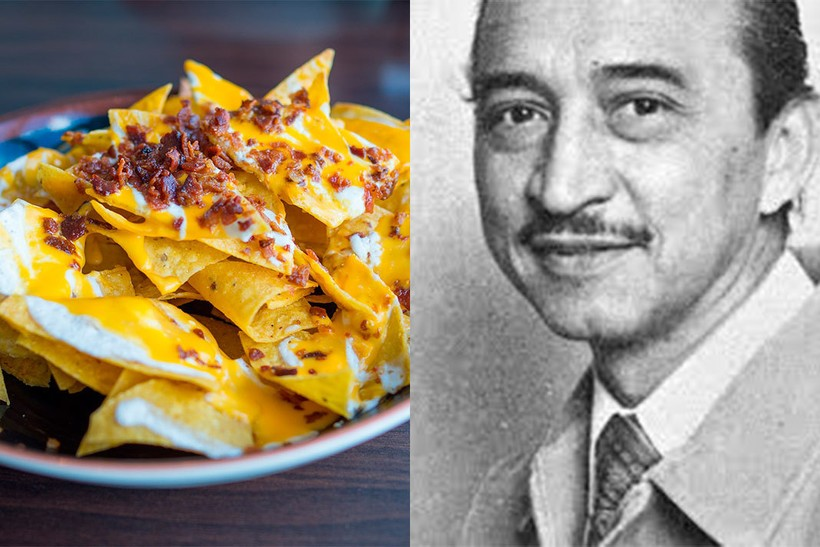
There is something quietly admirable about this kind of invention, a moment of improvisation that’s outlived far more serious events, born not of ambition but of circumstance. One does not set out to achieve culinary immortality; one simply hopes the cheese melts properly.
The Caesar salad, despite its imperial overtones, traces back to Caesar Cardini, a prohibition-era restaurateur in Tijuana, Mexico whose greatest trick may have been convincing the world that a mixture of lettuce, dressing, and theatrical tableside preparation deserved to bear a name with historical weight.

It’s less conquest than branding, less empire than ambiance. And yet, it persists - ordered daily with little regard for the fact that its namesake was neither Roman nor particularly interested in ruling anything beyond a dining room.
Even the leotard, now so thoroughly divorced from spectacle that it feels almost administrative, traces back to Jules Léotard, a French trapeze artist performing in the mid–19th century who had the practical idea of wearing something form-fitting so audiences could better appreciate the mechanics of his act. It was, by all accounts, a sensible innovation - clarity over flourish, function over distraction. That it would go on to become synonymous not with daring feats performed high above a crowd, but with far more grounded pursuits, is the sort of historical drift that feels less like legacy and more like quiet misplacement. One imagines Léotard, had he been consulted, might have preferred a slightly narrower interpretation.

And perhaps that is the quiet pattern here: these are not the towering figures of history, but the ones who, through accident or practicality, left behind something useful enough to outlive them. No monuments, no epics - just small, persistent reminders that sometimes the surest path to being remembered is not greatness, but convenience.
The Dubious Visionaries
If the accidental legends stumbled into immortality, this group marched toward it with intent - blueprints in hand, theories intact, and a firm belief that they were, if nothing else, improving things. History, ever the generous editor, agreed just enough to keep their names, while quietly revising the outcomes.
Consider diesel, named for Rudolf Diesel, who in the 1890s developed an engine far more efficient than its predecessors, envisioning a future of accessible, practical energy. By the early 20th century, his invention was beginning to reshape industry - ships, factories, entire systems of movement bending toward his design.

And then, in 1913, while traveling by ship across the English Channel, Diesel disappeared. His belongings were found neatly arranged in his cabin; he himself was not. Whether it was accident, suicide, or something more deliberate remains unresolved. It is a curious kind of legacy: a man builds a machine defined by compression and force, and then vanishes into open water, leaving behind an engine that’s never stopped running.
The saxophone, by contrast, feels almost like an apology. Adolphe Sax introduced it in the 1840s, envisioning an instrument that could bridge the gap between woodwinds and brass. Technically sound, musically versatile - and yet its eventual association with smoky jazz clubs and effortless cool seems less like fulfillment and more like a fortunate accident. Sax himself spent much of his life in financial trouble, which adds a faintly ironic note to an instrument now synonymous with smoothness.

Then there is Graham crackers, the legacy of Sylvester Graham, an early 19th century dietary reformer convinced that bland, wholesome food could suppress humanity’s more unruly instincts. His solution was a cracker so intentionally unexciting it bordered on moral instruction. That it would later become a key ingredient in desserts involving melted chocolate and marshmallows feels less like evolution and more like rebellion - proof that even the most disciplined vision can be quietly undone by sugar.

Finally, there is nicotine, courtesy of Jean Nicot, a 16th century French diplomat who introduced tobacco to the court of Catherine de’ Medici as a kind of medicinal curiosity - something to treat headaches, calm nerves, and, one assumes, generally improve the human condition. It was not yet the global habit it would become, just a fashionable novelty with supposed therapeutic benefits. That his name would go on to label the very substance responsible for tobacco’s addictive grip feels less like recognition and more like another clerical error. Few legacies age quite like this: a name attached not to a cure or even the plant itself, but to its consequences.

What unites these figures is not failure - far from it - but a certain mismatch between intention and outcome. They set out to shape the world in deliberate ways, and succeeded just enough to be remembered, though not always for the reasons they might have preferred. In the end, their names endure, attached not to their ambitions, but to whatever part of their work proved most… usable.
The Violent Branding Campaigns
And then, almost without warning, the tone shifts. The names remain, but whatever lightness once accompanied them has been replaced by something more utilitarian, more precise. These are not the byproducts of convenience or curiosity, but of efficiency. If earlier entries suggest that immortality can be stumbled into, these suggest it can also be engineered, refined, sharpened, and, when necessary, deployed.
Shrapnel takes its name from Henry Shrapnel, a British artillery officer of the late 18th and early 19th centuries, who devised a projectile designed explode in mid-air, scattering hot metal fragments across a wide area. It was, by military standards, an innovation - maximizing impact, extending reach, improving outcomes in ways that are best measured at a distance.

That his name would come to describe not just the device but the fragments themselves feels like an efficiency of language mirroring the efficiency of the weapon: nothing wasted, everything accounted for, including the man.
The guillotine, perhaps the most famously misunderstood legacy, is tied to Joseph-Ignace Guillotin, an 18th-century French physician who advocated for a more humane and egalitarian method of execution during the early days of the French Revolution. He felt that, if death was to be administered, it should at least be swift, consistent, and free from unnecessary suffering. History agreed, though perhaps with more enthusiasm than intended. The device became not just a method, but a symbol, its name fixed firmly to a period when efficiency and excess developed an uncomfortable partnership.
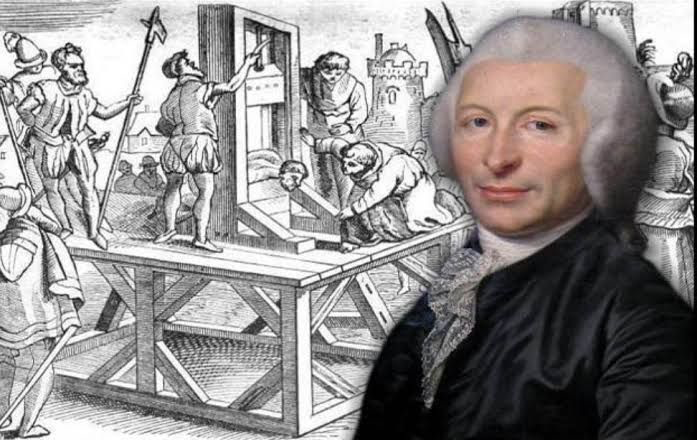
In one of history’s ongoing ironies, when Guillotin died in 1814, his family asked the French government to change the machine’s name. The government refused, so they changed their family name instead.
And then there is the derrick, a name that began with Thomas Derrick, a 17th-century London executioner whose particular aptitude for his work (executing over 3,000 people in his career) made him, in his own way, memorable. So memorable, in fact, that the gallows at Tyburn came to bear his name, and “derrick” became shorthand for both the structure and the man operating it.

Over time, as enthusiasm for public hangings waned, the word detached itself from its more terminal associations and drifted into new territory. By the 18th century it referred to crane-like lifting devices, and by the 19th century, to the skeletal towers used in oil drilling. It’s a quiet linguistic pivot: a tool once designed to end lives repurposed into one that hoists, builds, and extracts - proof that even the most specific forms of notoriety can, with enough time, be rebranded as infrastructure.
What binds these together is not merely violence, but organization. Each represents an attempt to make something unwieldy more controlled, more predictable, more effective. The names endure because the systems endured, and the systems endured because they worked - an observation that sits, as it should, with a certain amount of unease.
The Petty Immortals
If the previous names endured through invention or efficiency, these linger for smaller, more personal reasons - misfortune, ridicule, social friction, the sort of circumstances that rarely feel historic in the moment. There are no grand achievements here, no sweeping contribution to industry or progress. Just individuals who, through a particular alignment of events, found themselves distilled into something far more enduring than their original significance would seem to warrant.
Take boycott, derived from Charles Cunningham Boycott, the man against whom the first organized version of the practice was directed. In 1879, during a period of famine in Ireland, Boycott had the misfortune of being employed by absentee landlords to collect rent from struggling tenant farmers.

The Irish National Land League responded by persuading the local community to sever all ties with him. No one worked for him, spoke to him, or acknowledged him in any meaningful way - not even delivering his mail. It was a coordinated silence so complete that his name became the term for the act itself. It is a precise kind of irony: to be remembered indefinitely for being collectively ignored.
Then there is guy, which traces back to Guy Fawkes, the 17th-century conspirator involved in the failed Gunpowder Plot to blow up the English Parliament.

His capture and execution were followed by annual commemorations in which effigies - “Guys” - were paraded and burned. Over time, the name softened, shedding its association with treason and spectacle until it came to mean, quite simply, any man at all. It’s a remarkable descent - from would-be revolutionary to generic placeholder - suggesting that even the most dramatic gestures can eventually be absorbed into casual conversation. History, it seems, does have a sense of humor.

Tupperware, by contrast, carries the name of Earl Tupper, a 20th-century American inventor who developed airtight plastic containers that would go on to define an entire category of domestic storage. The real genius, however, may have been less in the product than in its distribution - those quietly persuasive gatherings known as Tupperware parties, where social ritual and commerce blended seamlessly.

That his name now resides in kitchen cabinets worldwide is a testament not just to utility, but to the subtle power of being useful in ways that don’t demand attention.
And finally, the dunce cap, an artifact of academic mockery tied, somewhat unfairly, to John Duns Scotus, a respected 13th century medieval philosopher and theologian whose followers were later ridiculed for their perceived stubbornness and outdated thinking.

The term “dunce” emerged as an insult, and the cap itself became a tool of public humiliation in classrooms - less an instrument of learning than of correction through embarrassment. It’s a particularly unkind legacy: a serious intellectual reduced, over time, to a symbol of foolishness, his name repurposed as a warning rather than a contribution.
What unites these figures is not greatness, nor even failure, but the peculiar efficiency with which their identities were simplified. Each became a shorthand - not for who they were, but for how they were perceived, used, or dismissed. In the end, their names endure not as monuments, but as minor conveniences, quietly doing their work in a language that rarely pauses to consider the people still attached to them.
What’s in a Name? Usually a Dead Guy.
There are worse ways to be remembered than not at all, though not many that are quite so quietly undignified. Most people, if they’re remembered, get a plaque, a line in a book, maybe a story told badly over dinner. A select few get something more enduring - entire lives, reduced to something you can point at and consume without ceremony. No context, no biography - just a word that arrives on cue and leaves without explanation, repeated daily by people who have no idea who you were and even less interest in finding out. It’s not legacy so much as absorption.

We inherit these words the way we inherit furniture - functional, slightly worn, and rarely questioned. They sit there, dependable, quietly carrying the weight of things we no longer examine. Somewhere along the way, the names stopped belonging to people and started belonging to us, repurposed for daily use like utensils pulled from a drawer. The original owners, wherever they are, have been edited out of the transaction.
And yet, every so often, something slips. A word sounds just unusual enough, just specific enough, to suggest it wasn’t always meant to describe what it now does. You pause as there’s the faint sense that you’ve brushed up against the edge of a story that no one felt compelled to finish. Not forgotten exactly. More… streamlined. Filed down until only the useful part remained.
Spend enough time with it and a pattern emerges. Not a grand theory - nothing so ambitious - just a quiet accumulation of small, persistent absurdities. Names that outlived their owners by attaching themselves to habits, objects, minor conveniences. A kind of accidental immortality, handed out unevenly and without much regard for dignity. The rest - ambition, meaning - gets edited out. What remains is what works. And what works, as it turns out, is rarely flattering. And, occasionally, not even accurate.
Author’s Note: This piece is not a warning against language, nor a suggestion that we stop using words altogether (tempting as that might be in certain conversations). It is, at most, a quiet reminder that the things we use most casually tend to have the longest history.
If you’re feeling inclined to lean into that realization - or simply reorganize your leftovers with a bit more historical awareness - you could do worse than something like Rubbermaid Easy Lock Tupperware. It does what all good legacies do: seals things up neatly, preserves what matters, and ensures that whatever you put inside will outlast your immediate intentions. Airtight, dependable, and blissfully unconcerned with how it got its name.
See what holds up here.

For those who prefer their history a bit less contained, Guillotine by Daniel Gerould offers a closer look at one of the more efficient contributions to both engineering and symbolism. It’s a reminder that even the most well-intentioned ideas can take on a life of their own - particularly when they’re built to be repeatable, scalable, and just humane enough to feel like progress.
Learn more here.

And if all of this has left you with the urge to bring a little order to the page - something clean, precise, and quietly decisive - the Firbon 12" Guillotine Papercutter is exactly what it sounds like. Straight lines, minimal effort, and none of the historical baggage. It’s less a tool than a small, controlled act of efficiency - proof that some ideas, once introduced, tend to stick around.
Take a whack at it here.

If you choose to purchase through the Amazon Associates links above, this publication may earn a small commission at no cost to you.


Well, that was a pleasant surprise. I especially liked the Diesel and Boycott beginnings.
What is particularly interesting is appears that none of these guys were looking for their inventions to be named after them.
Interesting that the Diesel engine is more efficient and more powerful than its cousin, the gas engine, but it seems like it’s less popular? Hmmmm, makes you wonder if had he lived, would it have become the opposite?
Something I would have never thought of. Thanks for bringing it to my attention. Reminds me of a show I saw on the history of swear words, which I think you would really enjoy