
The Butterfly Effect
- tripping8
- May 1
- 11 min read

There is, in most offices and nearly all governments, a quiet faith in the memo. It is typed, circulated, occasionally read, and almost always filed somewhere between “urgent” and “eventually.” The memo suggests order. It implies that somewhere, someone has written things down clearly enough that nothing truly important could be misunderstood. This is, of course, a charming belief - like thinking the existence of a menu guarantees a good meal.

Elsewhere, a man stands at a podium, shuffling pages that were drafted, revised, and approved by people who believe in drafts and revisions and approval. He is meant to say what is written, and he mostly intends to. The pages feel official in his hands, which is another way of saying they feel heavy with expectation. Still, there is always the possibility – however small - that he will say something else instead. Not out of rebellion. Out of instinct. Or fatigue. Or the vague sense that what he is about to say could be improved in the moment, which is how most irreversible things begin.
On a street not particularly designed for significance, a driver makes a turn that is either slightly too early or slightly too late. The correction is unremarkable, the sort of minor adjustment that rarely earns a second thought. Traffic doesn’t pause. The sky doesn’t darken. If anything, the moment passes with the quiet efficiency of something that will not be noticed until it is far too late to correct it properly.
These moments - half-read memos, improvised lines, missed turns - share a quality that’s easy to overlook and difficult to appreciate in real time: they don’t feel important. They feel like filler. Administrative. Forgettable. And yet, taken together, they begin to suggest something slightly inconvenient - that the events we later describe as inevitable, strategic, even historic, may owe less to grand design than to small, unremarkable decisions made quickly, imperfectly, and often by people who would rather be doing something else. Which, if true, would mean history is not so much written as it is… accidentally assembled.
Minutes from a Meeting No One Remembers Attending
We tend to imagine history as the outcome of decisive meetings filled with rooms full of people who understand the stakes, weigh the options, and arrive, after sober deliberation, at choices that shape the future. It’s a reassuring image. It suggests process. It suggests control. It suggests that somewhere along the line, someone had a firm grip on what was happening.
Ya, right.
Take the opening act of the World War I. The assassination of Archduke Franz Ferdinand is often presented as a clean, almost theatrical inciting incident - an archduke, a nationalist, a shot, and suddenly Europe is on fire. The reality is less choreography; more farce with consequences.

Earlier that day, a different conspirator had already made an attempt, throwing a bomb that failed to do its job and instead injured members of the entourage behind the Archduke’s car. The plan, such as it was, unraveled quickly. By all reasonable accounts, it was over. Gavrilo Princip, one of the remaining conspirators, did what people tend to do after a failed morning - he went to get something to eat. Meanwhile, the Archduke, determined to visit the wounded, set off again, only for his driver - navigating unfamiliar streets - to take a wrong turn. In correcting it, the car stalled. Not in some distant, symbolic location, but directly in front of Princip, who now found his abandoned target idling politely a few feet away. The shot that followed is often described as the spark that ignited a global war.

Which is one way of saying that one of the defining events of the 20th century hinged, in part, on a failed plan, a wrong turn, and a man who happened to stop for lunch at exactly the wrong time, for everyone involved.
Then there is the fall - more accurately, the sudden unraveling - of the Berlin Wall. In November 1989, an East German official named Günter Schabowski stands before reporters to announce new travel regulations. The policy itself is bureaucratic, cautious, and not especially dramatic. But when pressed on when the changes take effect, Schabowski - flipping through notes that appear less than definitive - responded, “as far as I know… immediately.” (

It’s a phrase offered without emphasis, almost casually. Within hours, crowds gather at border crossings, expecting passage. The guards, equally unsure, hesitate. And then, faced with a swelling public and a lack of clear instruction, they open the gates. A structure that had defined a geopolitical era begins to dissolve, not with a directive, but with a sentence that may not have been meant quite that way.
And finally, in a Soviet bunker in 1983, there is Stanislav Petrov, staring at a system that insists missiles are on their way.

Protocol is clear: report the launch, escalate the response. The machinery of deterrence depends on speed, certainty, and the absence of doubt. Petrov, however, hesitates - not because of a grand philosophical stance, but because something about the alert felt… off. Too few missiles. Too neat a pattern. He decides, against training, to wait. It’s not a dramatic rebellion. It’s a quiet pause. The alert is later confirmed to be a false alarm. The world continues, largely because one man chose to distrust a system designed to eliminate precisely that kind of hesitation.
Individually, these moments can be explained away - an error here, a misstatement there, a single act of intuition in an otherwise rigid system. Together, they begin to suggest a different pattern. Not one of careful orchestration, but of accumulated imperfections. Civilization, for all its claims to order, appears to run on something closer to a poorly managed group chat: messages arrive late, instructions are unclear, and occasionally, the outcome hinges on someone deciding simply not to respond at all.
While This Was Happening, No One Noticed
If the previous section suggested that history is occasionally steered by confusion, this is where it becomes clear that it’s often nudged along by something even less reassuring: people who are simply… occupied. Not negligent, exactly. Not incompetent. Just busy, mildly distracted, and operating under the perfectly reasonable assumption that today is not the day anything extraordinary will be required of them. Just individuals, moving through their day with the mild urgency of people who have other things to get to.
In 1605 we discover the Gunpowder Plot, which sounds dramatic because, in theory, it was meant to be. A group of English Catholics, frustrated with the Protestant monarchy, plan to blow up Parliament during its opening session - king included - using barrels of gunpowder stored beneath the building. It is, by any measure, an ambitious attempt at rewriting the political order in one decisive gesture. And it might have worked, if not for a letter. Not a grand revelation or a daring interception - just a quiet, somewhat cryptic note sent to William Parker, 4th Baron Monteagle, advising him to avoid Parliament that day.

Monteagle reads it. He does not dismiss it. He passes it along. Authorities investigate, discover Guy Fawkes guarding the explosives, and the plot collapses before it begins. An entire alternate version of British history - violent, abrupt, transformative - is undone not by force, but by a message that could just as easily have been ignored, misplaced, or read a little too late.
Then we have Alexander Fleming, who, before leaving for vacation in 1928, does not quite tidy his lab to the standards one might expect of a man on the verge of altering modern medicine. A window is left open. A mold spore - carried who knows how, from where - drifts in and settles into a petri dish that was never meant to host it. Fleming returns, notices that the mold has killed the surrounding bacteria, and – crucially - decides this is interesting enough not to throw away.

That’s the moment we remember. But the chain is longer and far less dignified: an open window, an unwashed dish, a spore with good timing, and a man just curious enough to pause. Antibiotics don’t begin with a breakthrough. They begin with something small, airborne, and largely accidental deciding to land in the right mess.
And, in 2003, we get the Space Shuttle Columbia disaster - a sequence of events that begins, improbably, with a piece of foam. During launch, a chunk of insulating material breaks loose and strikes the shuttle’s wing.

Not a dramatic explosion. Not even particularly unusual. Foam shedding had happened before. It’s noticed, discussed, logged - the bureaucratic equivalent of “we should probably keep an eye on that.” Engineers raise questions, request clearer imagery, suggest follow-up. The requests move through channels, lose a bit of urgency at each step, and eventually settle into that comfortable middle ground where something is acknowledged but not quite acted upon. Meanwhile, the shuttle continues its mission, orbiting Earth with quiet competence. It’s only upon reentry - when the damaged wing can no longer withstand the heat - that the earlier moment, the small, almost forgettable collision of foam and tile, reveals what it has been quietly setting in motion.

The butterfly here doesn’t flap its wings so much as drift, lightly and without intention, into the wrong place at the wrong time, with the consequences arriving later, precisely when no one can do anything about them.
What unites these moments is not their scale, but their texture. No one involved is aware they are inside anything resembling history. They’re going on vacation. They’re sorting through their mail. They’re making calculations. The decisions they make are not framed as consequential; they’re framed as practical, immediate, and, above all, ordinary. Like background noise - minor variables in an otherwise orderly system. And yet, they are precisely the kind of variables that the butterfly effect depends on: small inputs, barely noticed, that cascade outward into consequences no one involved was attempting to create.
Product Development, More or Less
By this point, it becomes tempting to believe the butterfly effect is reserved for wars, assassinations, and the occasional near-miss with global annihilation. Serious things. Important things. The kind of events that justify their own gravity.
But the pattern does not limit itself to moments of obvious consequence. It shows up just as reliably in places that are, on the surface, far less dignified, where the stakes feel lower and the decisions feel, if anything, a bit casual. Which is perhaps what makes them easier to miss.
Take the invention of the Microwave oven. In the 1940s, engineer Percy Spencer is working with radar equipment when he notices that a chocolate bar in his pocket has melted. This is not, by most professional standards, a breakthrough. It is an inconvenience. A mild betrayal by confectionery. But Spencer does something quietly consequential - he pays attention. One observation leads to another. Kernels of popcorn are introduced into the experiment, presumably with a degree of curiosity that would not survive a modern safety review. The chain unfolds from there: melted chocolate to controlled heating to a device that will eventually sit in millions of kitchens, quietly redefining what “cooking” means.

The butterfly, in this case, is a chocolate bar losing structural integrity resulting in an entire culture deciding that dinner should take three minutes and involve as little emotional investment as possible.
Then there is Viagra, which begins life with far more high-brow ambitions. Developed as a treatment for heart conditions, it performs adequately, though not spectacularly, in clinical trials. What it does do - reliably, and with increasing consistency - is something else entirely.

Participants notice. Researchers notice that participants notice. At some point, someone makes a decision that is less about correcting a mistake and more about embracing it. The intended outcome is quietly set aside in favor of the one that actually works. A pharmaceutical detour becomes the main road. The butterfly here is a side effect that refused to keep its head down resulting in a drug that reshaped not just a market, but a certain category of late-night advertising.
And then there is Buddy Holly.

n 1959, midway through a winter tour that seemed determined to test both endurance and patience, Holly decides he has had enough of unreliable buses and subzero travel conditions. More specifically, he would like to arrive at the next stop in time to do laundry - an ambition so modest it barely qualifies as a plan. So, he charters a small plane. Seats are limited. Choices are made, some casually, some by chance. The plane takes off. It does not arrive. The event will later be called “The Day the Music Died,” which is a grand way of describing a chain of decisions that begins, more or less, with a desire for clean clothes and a slightly more comfortable evening. The butterfly here is domestic. Practical. Entirely reasonable. The hurricane is cultural, permanent, and still referenced decades later by people who were not yet born when laundry became, unintentionally, historical.
What ties these together is not just their unpredictability, but their tone. None of these moments feel heavy enough to carry consequence. They feel experimental. Incidental. Almost optional. A melted candy bar, an unexpected side effect, a musician trying to stay warm and presentable. And yet, each sets off a chain of events that extends far beyond its origin, reshaping habits, industries, and, in some cases, entire slices of culture.
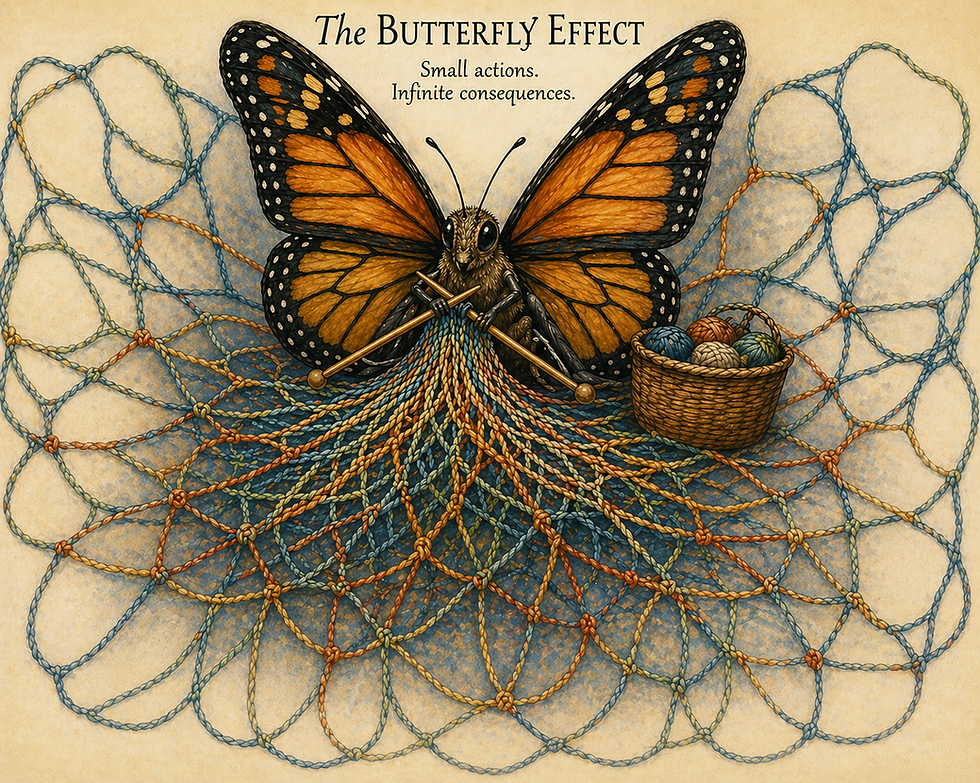
The Butterfly Effect
Most of what changes the world doesn’t look like it at the time. It doesn’t arrive labeled, doesn’t clear its throat before speaking. It looks like a small decision, made quickly, often by someone who would prefer to be somewhere else – finishing a meal, home, or at the very least not responsible for whatever comes next. A missed turn. A half-read memo. A choice made in the soft haze of “this will probably be fine.” And usually, it is. Until it isn’t.

Which begins to suggest something mildly unsettling: the butterfly effect isn’t an exception. It’s the operating system. A quiet, persistent mechanism humming beneath everything, stitching together small, forgettable details into outcomes no one involved was aiming for. Not destiny, exactly. Not chaos either. Something in between - a series of nudges, hesitations, and minor oversights that, when viewed from a safe historical distance, begin to look suspiciously like a plan.
The people inside these moments, of course, don’t recognize them as anything special. They’re not thinking in terms of history or consequence or narrative symmetry. They are thinking about what’s in front of them. A lab to leave. A letter to read. A report to file. Maybe a flight to catch, or a meeting to get through, or a vague sense that something should be looked at more closely, but not today. The connections - the clean lines of cause and effect, the satisfying logic of how one thing led to another - only appear later, when the story is told backward and edited for coherence.
But in real time coherence is most often absent. It just feels like life: slightly disorganized, occasionally absurd, and held together by decisions that seem too small to matter. Which might be the most honest part of it. Not that history is shaped by great men or grand ideas, but that it’s assembled, piece by accidental piece, by people doing their best with incomplete information and a mild preference for convenience. And somehow - through missed turns, melted chocolate, and the occasional well-timed hesitation - that’s enough to keep the whole thing moving forward.
Author’s Note: If you made it this far, you’ve probably come to terms with two things:
1. history is not nearly as organized as advertised, and
2. it doesn’t take much to tip it over.
If you want to see how that plays out on a human scale, try Buddy Holly: A Life from Beginning to End (link here). It’s a short, clean read - exactly the kind that reminds you how a 22-year-old musician, a winter tour, and a very ordinary decision about travel can ripple outward into something we’re still talking about decades later.

If you’d prefer a version of this idea that involves fewer plane crashes and more farm animals, there’s The Butterfly Effect (linked here). It’s a deceptively simple children’s story - one butterfly bumps into a bee, which bumps into something else, which bumps into something else, until the entire farm is in chaos. It’s charming, a little chaotic, and the same argument you just read, only with better illustrations and significantly lower stakes.

If you choose to purchase through the Amazon Associates links above, this publication may earn a small commission at no cost to you.


Interesting because I’ve never given the Butterfly Effect much thought….,, thank goodness for Stanislav Petrov!