
In Corn We Trust: A Love Letter to Bourbon

The glass sat in the late afternoon light like a small act of alchemy. Amber, gold, copper - depending on the angle and the ambitions of the person describing it. Around the world, people have spent centuries staring into such liquids and finding stories there. Kingdoms have risen and fallen over less convincing miracles. Entire industries have been built on the premise that what happens inside a wooden barrel is not merely chemistry, but something approaching magic. We are a species that likes to believe transformation is possible, especially when it can be poured over ice.

This tendency is hardly unique to bourbon. Humans have always possessed a remarkable gift for looking at perfectly respectable agricultural products and wondering how they might be improved through fermentation. Grapes became wine. Rice became sake. Sugarcane became rum. Agave became tequila. Somewhere along the way, someone discovered that with enough patience and experimentation, nearly every crop on Earth could be persuaded to participate in a conversation that would seem brilliant at the time and questionable the following morning.

What is unique is the reverence that follows. Give a liquid enough history, enough ritual, enough carefully curated mythology, and people begin speaking of it in hushed tones. They discuss notes of caramel, vanilla, tobacco, leather, toasted oak, dark cherries, and occasionally some flavor so specific it sounds less like a tasting note and more like an unresolved childhood memory. The fact that all this analysis is often centered on what began as an ordinary field crop is rarely mentioned. Perhaps because it spoils the mood. Nobody wants to spend three hundred dollars on a bottle only to be reminded that the journey began in a cornfield.

Which brings us to June 14th, International Bourbon Day - a holiday dedicated to one of humanity's most successful efforts to turn a humble grain into an object of admiration, debate, collection, and occasional obsession. It’s a day for celebrating bourbon in all its amber-glowing glory: its history, its rules, its peculiar traditions, and its improbable rise from frontier practicality to global icon.
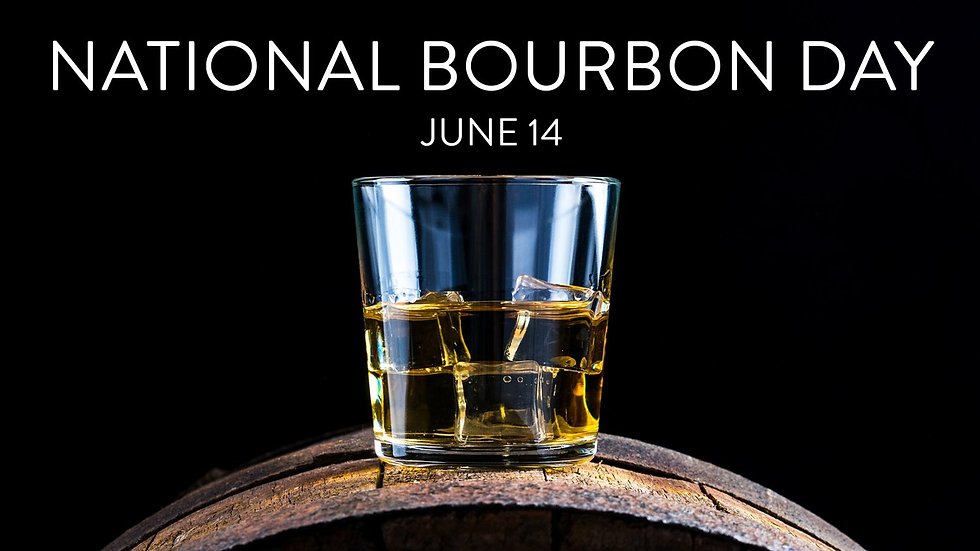
Because if there is one thing humanity loves almost as much as inventing alcohol, it’s inventing reasons to celebrate it.
How Corn Found Its True Calling
Like many of history's great achievements, bourbon was not the result of a grand vision. Nobody gathered around a frontier campfire and declared, "Let us create a world-renowned spirit that future generations will debate endlessly on internet forums." Bourbon emerged for the same reason many inventions do: necessity, practicality, and a mild reluctance to haul heavy things over long distances. In the late eighteenth and early nineteenth centuries, farmers on the American frontier found themselves with an abundance of corn and a shortage of efficient transportation. Moving sacks of grain over rough roads and mountain trails was difficult. Turning that grain into whiskey, however, made the journey considerably easier.
Corn proved particularly useful because there was so much of it. It grew well, produced reliable harvests, and had a stubborn tendency to accumulate faster than people could consume it. Distilling offered a solution. Grain became whiskey, whiskey became easier to transport, and easier transportation became money. What began as a practical response to logistical challenges gradually evolved into a craft. Then a tradition. Then, as humans inevitably do, a mythology.

Exactly where bourbon got its name remains a subject of debate. Some point to Bourbon County in Kentucky. Others suggest Bourbon Street in New Orleans, where barrels of whiskey arriving from the interior may have been sold. Historians continue to argue the finer points, proving once again that if enough time passes, even a story about corn can become controversial. Whatever its origin, bourbon slowly established itself as something distinct, shaped by geography, local ingredients, and production methods that would eventually become formalized into law.
There is something wonderfully human about bourbon's origin story. It wasn't born from luxury. It wasn't created for connoisseurs. It wasn't designed to impress anyone. It was simply a practical solution to an everyday problem. The fact that this solution eventually became a celebrated spirit enjoyed around the world serves as yet another reminder that civilization often advances through a series of happy accidents. Someone wants to solve a problem, and two centuries later there is an international holiday devoted to the result.

The Rules of the Barrel
For a spirit that began as a practical frontier workaround, bourbon eventually acquired an impressive collection of rules. In fact, bourbon may be one of the few products on Earth whose legal requirements are discussed with greater enthusiasm than its flavor. This is because bourbon is not merely a whiskey. It is a whiskey that has successfully navigated a bureaucratic obstacle course.
To be called bourbon, it must be made in the United States. The grain mixture must contain at least 51 percent corn. It must be distilled to no more than 160 proof, entered into the barrel at no more than 125 proof, and aged in brand-new charred oak barrels. Nothing may be added to alter its flavor or color. These regulations are not suggestions. They are laws, enacted by a US Congressional resolution in 1964.

Somewhere along the line, humanity decided that fermented corn needed legal protection, and remarkably, everyone agreed.
The result is a spirit with one of the most clearly defined identities in the world of alcohol. A Scotch whisky producer can point to Scotland. A tequila producer can point to Mexico. Bourbon points to a lengthy list of federal regulations and says, "The paperwork is part of the charm." This may not sound romantic, but rules have a curious way of becoming tradition. Tradition eventually becomes heritage, and heritage, given enough time, becomes something people are willing to pay extraordinary amounts of money to discuss.

And bourbon enthusiasts often speak of these requirements with near-religious devotion. Mention that a whiskey doesn't meet one of the criteria and watch the mood shift. Conversations become serious. Eyebrows lower. Historical precedents are cited. Definitions are clarified. It’s like accidentally questioning the rules of cricket in England or suggesting that perhaps not every grandmother's recipe is sacred. Every culture has its boundaries. Bourbon simply drew its line at 51 percent corn and a charred oak barrel.

The Great Barrel Conspiracy
If bourbon has a secret, it’s this: the barrel is doing an astonishing amount of the work. Left to its own devices, newly distilled whiskey is clear, fiery, and possessed of all the subtlety of a marching band in a library. It’s the charred oak barrel that transforms it into the amber-colored spirit people swirl thoughtfully in expensive glassware. The barrel contributes the color, much of the flavor, and a considerable portion of the character. In many ways, bourbon is less a product than a long-term collaboration between grain and wood.
The process is deceptively simple. Freshly made spirit is placed into new charred oak barrels and left alone. Over the years, temperature changes cause the liquid to expand into the wood and contract back out again. During these countless journeys, the whiskey extracts compounds that create the familiar notes of vanilla, caramel, spice, smoke, and oak. Distillers often explain this process with great enthusiasm, though it can be summarized as follows: the bourbon repeatedly bumps into the barrel until it learns some manners.

The barrel's influence is so important that bourbon law requires a brand-new charred oak barrel every single time. One barrel. One bourbon life. After that, the barrel moves on to a second career. Some travel to Scotland to age whisky. Others head to the Caribbean for rum, or elsewhere to help shape tequila, beer, wine, and a surprising variety of spirits. In a sense, the humble bourbon barrel becomes one of the world's great travelers, quietly collecting passport stamps long after the bourbon itself has been bottled and consumed.
Yet despite all this, the barrel receives remarkably little recognition. Bourbon enthusiasts discuss master distillers, legendary brands, and rare releases, while the barrel sits silently in the background doing what it’s always done. It’s a familiar arrangement. History is full of indispensable contributors who never quite make the headlines. The barrel simply joins a long list of teachers, editors, road crews, stagehands, and middle managers whose greatest accomplishment may be making the star of the show look good.

A Brief World Tour of Human Ingenuity
One of the easiest mistakes a bourbon enthusiast can make is assuming bourbon occupies some special category apart from the rest of humanity's spirited accomplishments. It does not. Bourbon is, instead, a distinguished member of a much larger family: the collection of drinks created when people looked at local crops and decided they had greater ambitions. The Scots had barley and gave us whisky. The Japanese became alarmingly good at turning rice into sake. Mexico transformed agave into tequila and mezcal. France turned grapes into cognac. The Caribbean turned sugarcane into rum. Across centuries and continents, people repeatedly arrived at the same conclusion: agriculture is important, but alcohol is memorable.

What makes bourbon unique is not that it exists, but that it reflects the landscape from which it emerged. Every great spirit tells a story about the place that created it. Scotch speaks of rugged highlands, peat bogs, and weather that seems personally offended by human happiness. Tequila carries the sun-baked fields of Jalisco in every bottle. Cognac evokes vineyards, tradition, and centuries of French determination to elevate nearly everything into an art form. Bourbon's story is one of cornfields, frontier settlements, river trade, and an abundance of oak trees waiting patiently to become barrels.
And then there are the facts. Every great spirit accumulates myths, legends, and colorful stories, but bourbon possesses a collection of truths that sound suspiciously fictional. Kentucky alone produces roughly 95 percent of the world's bourbon. More remarkably, there are significantly more bourbon barrels aging in Kentucky (over 7 million) than there are people living there (approximately 4.6 million). Imagine an entire region where barrels outnumber citizens and somehow this is considered perfectly normal. To the rest of the world, it sounds less like an industry statistic and more like the premise of a particularly niche dystopian novel.

You can pack bourbon in your checked luggage, but it's illegal to fly with anything over 140 proof because highly concentrated alcohol is considered a fire hazard. Bourbon also played an unexpected role in shaping the United States. Taxes on distilled spirits helped fund portions of the early federal government, and U.S. President Harry Truman's doctors advised him to start every morning with a shot of bourbon to "fix" what ailed him, a routine he strictly followed.

For a drink that began as a practical way to move excess corn, bourbon has had an extraordinary journey. Not many spirits can claim to have influenced government finances, received medical endorsements, and still managed to become the preferred companion of a quiet evening on the porch.
The Bourbon Personality Test
Every spirit attracts a certain type of person. Not always, of course. There are exceptions to every rule. But spend enough time in bars, restaurants, tasting rooms, and backyard gatherings, and patterns begin to emerge. Tequila drinkers often possess an admirable optimism about tomorrow. Scotch enthusiasts tend to enjoy discussing history nearly as much as they enjoy discussing whisky. Gin lovers frequently appreciate complexity, botanical ingredients, and jump at the opportunity to use words like "juniper" in casual conversation. Bourbon drinkers, meanwhile, come in several distinct varieties, each convinced they have discovered the correct way to enjoy it.
First, there is The Collector.

The Collector owns dozens of bottles, sometimes hundreds. Many remain unopened. These bottles are not merely beverages; they are investments, conversation pieces, and occasionally retirement plans. The Collector speaks in limited releases, warehouse numbers, and allocation lists. Somewhere in the home is a spreadsheet. There is always a spreadsheet. Scotch has its collectors as well, of course, but bourbon collectors possess a unique ability to transform a liquor store delivery schedule into something resembling a military intelligence operation.
Then there is The Purist.

The Purist drinks bourbon neat and regards ice with suspicion. Water may be tolerated in microscopic quantities if accompanied by a lengthy explanation. Cocktails are viewed as an unnecessary distraction from the spirit's true character. The Purist can identify tasting notes invisible to ordinary mortals and often speaks of "the finish" with the seriousness of a Supreme Court justice delivering a ruling. Every spirit has its purists - wine has sommeliers, tequila has agave traditionalists, and Scotch has peat evangelists - but bourbon purists have elevated conviction into a performance art.
At the opposite end of the spectrum stands The Cocktail Person.

For this individual, bourbon is not the destination but part of the journey. It appears in Old Fashioneds, Manhattans, Whiskey Sours, Mint Juleps, and any number of creative concoctions. The Cocktail Person is generally less concerned with provenance and more concerned with whether everyone is having a good time. This may explain why they are often the happiest person in the room. While enthusiasts of every spirit occasionally descend into debate, the Cocktail Person has quietly moved on to a second drink and a better conversation.
Finally, there is The Casual Drinker.

The Casual Drinker orders bourbon, enjoys bourbon, and feels no compelling need to write a dissertation about bourbon. They know what they like, they like what they know, and they are largely indifferent to arguments about barrel char levels, warehouse placement, or whether a particular release contains notes of caramelized cherry wrapped in saddle leather and autumn rain. The Casual Drinker is the bourbon equivalent of the person who enjoys wine without becoming a sommelier, sushi without becoming a critic, or coffee without opening a podcast. They may, in fact, be the wisest of them all.
Of course, most of us are some combination of these personalities. Given enough time, even the Casual Drinker can become a Collector. The Collector occasionally becomes a Purist. The Purist discovers cocktails. The Cocktail Person buys a bottle they swear they're saving for a special occasion. In the end, the categories matter less than we'd like to believe. Whether your spirit of choice is bourbon, Scotch, tequila, rum, cognac, sake, or something distilled in a remote corner of the world by people whose grandparents perfected the recipe, the ritual is largely the same. We gather, we pour, we tell stories, and we convince ourselves that this particular bottle has something important to say. And sometimes, against all odds, it does.
In Corn We Trust: A Love Letter to Bourbon
There’s a tendency, particularly in the modern world, to believe that every problem can be solved with greater speed. Faster shipping. Faster communication. Faster results. We have become remarkably efficient at eliminating waiting from our lives. Yet bourbon remains stubbornly indifferent to all of it. You can build a bigger distillery. You can buy better equipment. You can hire smarter people. But eventually, the whiskey goes into the barrel, the warehouse door closes, and time takes over. The bourbon will be ready when the bourbon is ready.

Maybe that's why bourbon has become something more than a drink. Beneath the history, regulations, tasting notes, and collector culture lies a philosophy that feels increasingly rare. It’s built on patience. Grain becomes spirit. Spirit becomes bourbon. Not overnight, not on demand, and certainly not because someone found a clever shortcut. The barrel insists on a lesson humanity has spent centuries trying to avoid: some things simply take as long as they take.
Along the way, there are losses. Distillers refer to the portion that evaporates through the barrel as the Angel's Share - the whiskey that quietly disappears into the air each year, suggesting reassuringly that the heavens maintain a fondness for bourbon. Less frequently discussed is the Devil's Cut, the bourbon that remains trapped deep within the wood itself, stubbornly refusing to leave the barrel. Between the angels taking their portion and the devil claiming his, bourbon seems to acknowledge an uncomfortable truth about life: nobody gets to keep all of it. Time takes its share. Circumstances take their share. The trick is appreciating what remains.

And maybe that's why bourbon resonates so deeply, not just in America but around the world. Every culture has its spirits. Every culture has its rituals. Yet bourbon's story feels oddly universal. It begins with something ordinary. It spends years becoming something else. It emerges a little darker, a little smoother, and a great deal more interesting than when it started. Not because it avoided hardship, but because it endured it.
So, on this International Bourbon Day, raise a glass if you're so inclined. Neat, on the rocks, in an Old Fashioned, or however tradition dictates where you happen to be. Appreciate the corn, the barrel, the years of waiting, and the generations of people who perfected the process largely by trial, error, and stubborn persistence. Then take a sip and enjoy the moment. The angels have already taken their share. The devil has claimed his. What's left in the glass belongs to you, and for now, that's more than enough.

Authors Note: If today's celebration of bourbon has left you thirsty and feeling inspired to deepen your appreciation for America's most convincing argument for corn, allow us to recommend The Bourbon Bible by Eric Zandona.

Despite sounding like it might contain commandments such as "Thou Shalt Not Waste Good Bourbon in Questionable Cocktails," it’s actually a comprehensive guide to the history, production, tasting notes, distilleries, and personalities that make the bourbon world so endlessly fascinating. Whether you're a seasoned enthusiast or someone who still believes "small batch" refers to a bakery, it's an entertaining and surprisingly useful companion.
And because no discussion of bourbon would be complete without at least a small nod to presentation, consider a set of Old Barrel Whiskey Glasses and Ice Molds.

The glasses are handsome, the oversized ice melts slowly, and together they create the impression that you know exactly what you're doing, even if you're secretly Googling the difference between a mash bill and a mosh pit. Sometimes half the enjoyment of bourbon is the ritual. The other half, of course, is the bourbon.
If you decide to purchase through these Amazon Associate links, we may earn a small commission at no additional cost to you. Think of it as our share of the barrel. The angels have theirs. The devil has his. We’re just hoping to cover the ice. 🥃😉
As always, any purchases made through these links help support the continued production of essays examining the thin and increasingly questionable line between human civilization and organized nonsense.



Ahhhh. Bourbon! I have sang (poorly mind you) many a Frank Sinatra tune to a delicious glass of Woodford Reserve on a big round piece of ice!
So Doctors in the 50’s were not very trustworthy! Bourbon for what ails you, cigarettes to calm the nerves! Whew……. Those guys probably recommended raw milk and not to take vaccines, but that’s another story.
Embarrassingly, I didn’t know the 14th was National Bourbon Day! So I will gladly lift a glass of Woodford Reserve over ice and hey I might go crazy and have a Dry Manhattan!