
The Cards We’re Dealt

Politics notwithstanding, there are few situations in civilized life in which lying is not only permitted but admired. We generally discourage it in courtrooms, marriages, job interviews, and conversations beginning with the words “I only had two drinks.” Yet put four people around a table, scatter some money between them, and suddenly deception becomes a skill. A man who lies convincingly enough may be called clever. A woman who recognizes the lie may be called brilliant. And everyone shakes hands afterward. Usually.
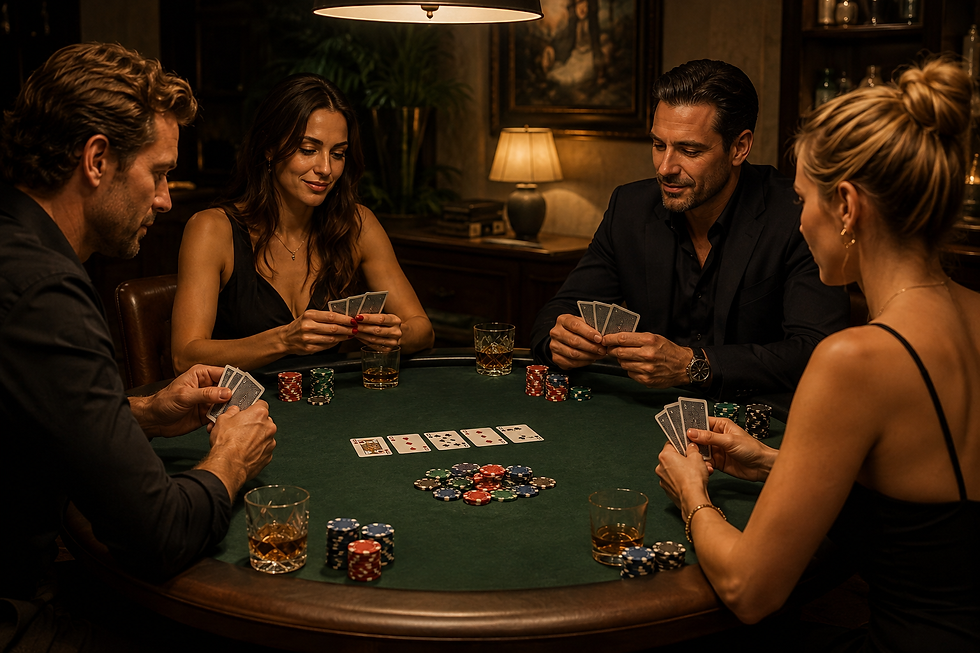
The strange thing is how little information anyone needs to begin distrusting everyone else. A few pieces of painted cardboard will do. Someone looks at his and smiles. Someone else looks at hers and does not. A third person pushes money toward the center of the table with the serene confidence of a man who either possesses something extraordinary or has made a terrible decision and would now very much like company. Nobody knows which. That’s the point.
For centuries, human beings have devised increasingly elaborate ways to test this particular talent. We’ve changed the cards, the number of players, the value of the hands, the rules for betting, and the acceptable amount of money one may lose before going home and reconsidering one's relationship with probability. We’ve played in palaces and saloons, on riverboats and kitchen tables, in casinos bright enough to erase all evidence of night, and now on glowing screens against people whose faces we may never see. The surroundings change. The suspicion does not.

Eventually we gave this peculiar little exercise in probability, courage, greed, patience, observation, and socially acceptable dishonesty a name: poker. Its history is far less straightforward than the game would have you believe, its relatives can be found scattered across cultures and centuries, and its greatest lesson may have very little to do with cards. Because poker has never really been about what you're holding. It's about convincing everyone else that you know something they don't.
Before Poker Was Poker
Poker has the sort of ancestry that would make a genealogist quietly close the file and go for a drink. There’s no single inventor, no tavern where someone suddenly slapped five cards onto a table and announced that humanity had been waiting for this. Instead, its family tree wanders through several countries and centuries, collecting ideas along the way. Playing cards themselves probably originated in China, where references to card-like games appear around 600 AD during the Tang dynasty, before cards spread westward through Asia and eventually into Europe.

By the sixteenth century, Europeans were already playing betting games such as the Spanish Primero, in which players held small hands, wagered on their strength, and – crucially - could behave as though those hands were considerably better than they actually were.
Persia supplied another intriguing relative. As-Nas, played with a small deck containing repeated ranks, involved betting on combinations and bluffing opponents, similarities that once led historians to describe it confidently as a direct ancestor of poker.

The connection is no longer considered quite so tidy. In Europe there was also the French Poque, and the German Pochen, each belonging to a broad family of games in which cards, betting, escalating stakes, and the ability to persuade other people that you were stronger than you appeared mattered at least as much as the cards themselves. Poker, in other words, seems less like an invention than a stew: ingredients arrived from different places, somebody kept adding things, and eventually everyone forgot who brought what.
What survived all this cultural wandering was not a particular deck or set of rules, but an idea. A card game became much more interesting once players were allowed to bet on information known only to themselves. That small innovation changed everything. Luck still determined what you were dealt, but human behavior determined what happened next. You could possess the best cards and earn almost nothing because everyone fled. You could possess terrible cards and somehow convince three or four perfectly sensible people to surrender money to you. Somewhere along the way, humanity had discovered that uncertainty could be turned into entertainment.
THE TABLE, HAND ONE: THE BLUFFERS
The Players: Niccolò Machiavelli · Cleopatra · Giacomo Casanova · Grigori Rasputin
Four people who made careers out of persuading others to believe things that were not necessarily in their best interests. Machiavelli understood power. Cleopatra understood people who had it. Casanova understood people he wanted to sleep with. Rasputin somehow convinced the Russian imperial family that an unwashed Siberian mystic with alarming eyes deserved unrestricted access to the palace.

Machiavelli looks at his cards once and places them facedown. Cleopatra barely looks at hers; she’s more interested in Machiavelli. Casanova is smiling at Cleopatra, which means he’s already forgotten why he came. Rasputin stares at his cards for an uncomfortably long time, then pushes everything he has into the middle. Machiavelli studies him. Cleopatra studies Machiavelli studying him. Casanova studies Cleopatra. Nobody studies the cards. One by one, they fold.
Rasputin turns over a pair of fives.
Winner: Rasputin.
Of course it is. Machiavelli could understand ambition. Cleopatra could understand seduction. Casanova practically franchised it. But none of them was prepared for a man whose greatest historical talent was making perfectly intelligent people wonder, against all available evidence, whether perhaps Rasputin knew something they didn't. The cards were almost beside the point.

Poker was ready to be invented.
Poker Comes to America
By the early nineteenth century, the ingredients had crossed the Atlantic and found precisely the sort of place where they could become dangerous: New Orleans. The earliest recognizable form of poker appears there around the 1820s and ‘30s, played with twenty cards by four players, each receiving five. From New Orleans it traveled up the Mississippi on the riverboats that carried cotton, merchants, adventurers, and professional gamblers. The boats provided an ideal laboratory.

Passengers had time, money, strangers to play against, and nowhere particularly convenient to leave when things went badly.
The game expanded as it traveled. The twenty-card deck became fifty-two. Draw poker allowed players to replace cards and introduced another layer of uncertainty. Stud followed. During the American Civil War, soldiers carried poker between camps and regions, helping spread variations across the country. Afterward it moved west with everyone else, turning up in mining towns, frontier settlements and saloons, where the image of the poker table became so thoroughly attached to the mythology of the American West that it’s now difficult to imagine a nineteenth-century saloon without one. Apparently, every establishment was legally required to contain whiskey, swinging doors and at least one gentleman quietly accusing another of cheating.
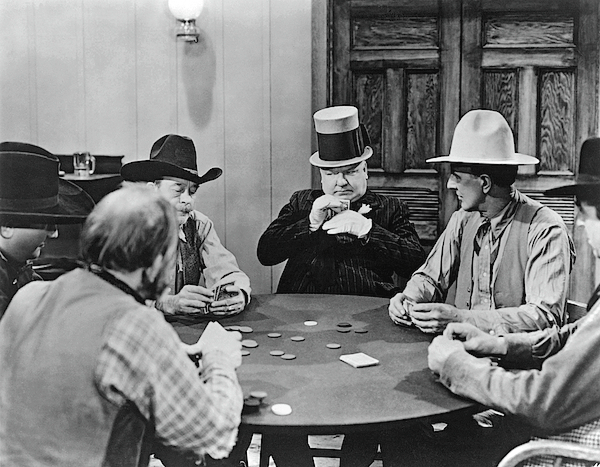
But poker suited America for reasons beyond geography. This was a country increasingly populated by people meeting strangers: migrants, soldiers, traders, prospectors, businessmen, drifters and people whose previous employment history was best left in another state. Poker required no introduction and very little trust. In fact, mistrust was useful. Sit down with five people you had never met, place some money between you, and within minutes you were making judgments about their courage, honesty, intelligence and financial stability based largely on the way one of them moved his eyebrows. It was social mobility with cards.
THE TABLE, HAND TWO: THE GAMBLERS
The Players: Theodore Roosevelt · Ernest Hemingway · Amelia Earhart · P.T. Barnum
Four people with unusually relaxed attitudes toward risk. Roosevelt charged up San Juan Hill and later explored an Amazonian river that nearly killed him. Hemingway drove ambulances near the front in one war, reported from others, hunted large animals and occasionally seemed suspicious of any afternoon that didn’t contain a bottle of gin and the possibility of injury. Earhart flew aircraft across oceans when aircraft still had a rather experimental relationship with staying in the sky. Barnum repeatedly risked money on the proposition that the public would pay to see almost anything if you described it enthusiastically enough.

Roosevelt raises immediately. Hemingway raises him. Roosevelt raises again. Hemingway takes this personally. Earhart watches quietly while the two men transform a card game into a referendum on masculinity. Barnum, holding cards that would normally inspire a discreet retreat, announces his raise with such confidence that everyone begins to suspect they are witnessing something extraordinary.
Roosevelt pushes everything in. Hemingway follows because Roosevelt did. Earhart folds. Barnum calls. Roosevelt has a pair of threes. Hemingway has a pair of fours. Barnum has a pair of sixes.
Winner: P.T. Barnum.
It could hardly have ended otherwise. Roosevelt spent much of his life demonstrating that the appropriate response to danger was to move closer to it. Hemingway turned risk into both biography and brand. Earhart, sensibly, understood that courage and recklessness were not the same thing. But Barnum had built an empire on a principle perfectly suited to poker: the thing itself matters considerably less than your ability to convince people that they are looking at something remarkable. Roosevelt demands another hand. Hemingway demands another drink. Barnum suggests charging admission.

The World Deals Its Own Cards
America may have given modern poker its mythology, but it never had a monopoly on the underlying idea. Across the world, cultures developed card games built around combinations, betting, incomplete information and the ancient pleasure of watching someone confidently wager money they may shortly regret. Britain had Brag, whose lineage stretches back centuries and whose name rather efficiently summarizes the required personality. India developed Teen Patti, usually played with three cards and deeply embedded in social gatherings and festivals such as Diwali.

In China and across parts of Asia, games evolved along different lines, sometimes emphasizing the arrangement and comparison of multiple hands rather than one dramatic showdown. Different rules, different decks, different traditions; remarkably similar expressions when somebody realizes the person opposite them may be bluffing.
As poker itself spread internationally, countries began tinkering with that too. Chinese Poker gives each player thirteen cards to divide into three hands, replacing much of the conventional betting drama with the quieter anxiety of realizing you arranged everything incorrectly five minutes ago. Manila, once particularly popular in Australia, uses a stripped deck and community cards.

Irish Poker begins by giving players four hole cards before requiring them to discard two, which seems a rather Irish solution to abundance: enjoy having everything for a while, then accept that some of it must eventually go. Variations multiplied wherever players gathered because no card game in human history has apparently survived prolonged contact with a group of friends without somebody saying, “That's not how we play it here.”
Then came Texas Hold ’em. Simple enough to learn, difficult enough to spend a lifetime misunderstanding, it spread from Texas through Las Vegas and eventually across the world. Two private cards, five community cards and enough possible decisions to ruin an otherwise pleasant evening.

Hold ’em became the dominant language of international poker, particularly in tournaments and online, allowing players from vastly different cultures to sit at the same table and immediately understand one another. Poker had become global, but the old ingredients remained: patience, aggression, deception, timing and the ability to recognize when a brilliant plan had become a terrible one.
THE TABLE, HAND THREE: THE STRATEGISTS
The Players: Sun Tzu · Napoleon Bonaparte · Hannibal Barca · Admiral Horatio Nelson
Four commanders who spent their lives thinking about position, timing, deception and the unpleasant consequences of allowing an opponent to dictate the battlefield. Napoleon conquered much of Europe. Hannibal marched an army, including elephants, across the Alps because apparently going around seemed insufficiently memorable. Nelson built his reputation by attacking when conventional wisdom suggested greater caution. Sun Tzu wrote an entire philosophy of warfare around knowing when to fight, knowing when not to fight, and why the enemy should ideally be confused about which one you have chosen.

Napoleon wins the first few hands and immediately begins behaving as though the table has been annexed. Nelson responds by attacking whenever Napoleon does. Hannibal spends several minutes trying to determine whether there is some way to approach the pot from behind. Sun Tzu folds. And folds. And folds again. Napoleon notices. A man who refuses battle must be afraid of it. His stack grows, his confidence grows faster, and eventually he raises heavily into Sun Tzu. For the first time all evening, Sun Tzu raises back. Napoleon pauses. Then calls. Sun Tzu turns over the winning hand.
Winner: Sun Tzu.
Napoleon understood how to seize the initiative but not when to stop, Nelson how to attack with terrifying commitment but had never shown much enthusiasm for self-preservation, and Hannibal how to achieve the impossible but not how to turn a battle victory into final victory. Subtle men, these were not. Sun Tzu, however, left behind the rather less cinematic observation that winning without unnecessary battle is generally preferable to heroic disaster. Napoleon demands a rematch. Sun Tzu declines. He has already won.

Poker Isn't Really a Card Game
For all the attention given to straights, flushes and the statistical tragedy of needing one particular card, poker is ultimately played somewhere considerably less reliable than the deck: inside the human brain. The mathematics matters, of course. Good players calculate probabilities, understand the odds and know that hope is not generally recognized as a sound betting strategy. But poker adds something mathematics alone can’t solve. The cards are hidden. The people are not. Every hesitation, wager, glance and suspiciously casual sip of a drink becomes information, or appears to be information, which is often even more dangerous.

This is where the brain begins contributing its work. We hate losing more than we enjoy equivalent gains, which encourages us to chase money already disappearing from the table. We become attached to chips we've put into a pot because abandoning them feels like admitting we were wrong. We remember the miraculous bluff that worked and quietly misplace the six foolish ones that didn't. A player can make a statistically excellent decision and lose, then make an appalling one and win, and the second experience is often the one the brain chooses to turn into a life lesson.
And that may be poker's most useful lesson. A good decision and a good outcome are not the same thing. You can make the correct choice with the information available and still lose everything in front of you. You can ignore probability, misread your opponent, make a ridiculous bet and be rewarded because the final card happened to rescue you.

We’re uncomfortable with this because we prefer a universe in which intelligence and discipline reliably produce success while stupidity receives an invoice. Poker keeps reminding us that chance never signed that agreement. The skill is not knowing that you will win. It’s making the best decision you can while knowing perfectly well that you may not.
THE TABLE, HAND FOUR: THE BRAINS
The Players: Albert Einstein · Sigmund Freud · Charles Darwin · Leonardo da Vinci
Four men who changed how we understand the universe, the mind, life itself and almost everything Leonardo happened to look at for more than ten minutes. Einstein has mathematics. Freud has psychology. Darwin has adaptation. Leonardo has perhaps the most inconveniently curious mind ever seated at a card table. If intelligence alone determines the winner, this should be the finest poker game in history. Which is precisely why intelligence alone will not determine the winner.

Einstein calculates the odds before calling. Freud ignores his cards and watches Einstein, increasingly convinced that the physicist's betting reveals an unresolved childhood conflict. Darwin loses several early hands, notices what the others are doing, and allows his strategy to evolve accordingly. Leonardo plays enthusiastically for twenty minutes before becoming interested in the mechanics of shuffling and sketching a machine that could apparently do it better.
Freud bluffs Einstein. Einstein calculates that Freud probably isn't bluffing. Darwin notices that Freud knows Einstein will calculate this. Leonardo asks whether anyone has a compass. By the final hand, Darwin has quietly accumulated most of the chips.
Winner: Charles Darwin.
Einstein spent his life looking for the underlying laws governing a universe that, inconveniently for poker, does not reveal all its cards. Freud was so committed to finding hidden motives that a man simply betting a strong hand would eventually become suspicious. Leonardo's notebooks contain inventions, anatomical studies, flying machines, weapons, architecture and observations on practically everything except the advantages of finishing one project before beginning another. Darwin had the useful historical habit of watching what happened, accepting that circumstances changed, and adjusting the explanation accordingly. At this table, while everyone else was trying to prove how clever he was, Darwin simply adapted.

Freud explains that he wanted Darwin to win. Einstein requests the deck for further study. Leonardo has redesigned it.
When Poker Learned to Perform
For most of its history, poker was entertainment for the people sitting at the table and almost nobody else. This was understandable. Watching strangers play cards is not an obvious spectator sport, particularly when the most important cards are deliberately hidden from view. Boxing offers punches. Football offers goals. Horse racing offers horses moving very quickly in an agreed direction. Poker offered several people sitting almost completely still while occasionally pushing small plastic discs across a table. Las Vegas gave it glamour, and the World Series of Poker, first held in 1970, gave it a championship, but for years watching poker remained largely an activity for people who already understood why nothing happening could be extremely exciting.

Then television discovered the hole-card camera. Viewers could suddenly see the players' hidden cards while the players could not see one another's, transforming the audience from confused observer into the only person in the room who knew the truth - for once, the casino had given something away for free. We could watch someone confidently bluff with nothing. We could watch an opponent agonize while holding the better hand. Every twitch and hesitation became dramatic because we knew what the people involved did not. Television had stumbled upon something wonderfully suited to human nature: it allowed millions of strangers to sit at home knowing the correct answer while watching someone else make the wrong decision.
Online poker took the transformation further. Players no longer needed a casino, a riverboat, a kitchen table or even trousers suitable for public viewing. By the early 2000s, millions were playing online, and the combination of internet poker, televised tournaments and the improbable 2003 World Series victory of amateur Chris Moneymaker helped ignite a global boom.

Poker acquired celebrities, sponsorships, enormous tournaments and audiences who learned that a raised eyebrow could occasionally contain more drama than an explosion. A private game built around concealing information had become mass entertainment by revealing the secret to everyone except the people whose money depended on it.
THE TABLE, HAND FIVE: THE PERFORMERS
The Players: Oscar Wilde · Mark Twain · Marilyn Monroe · Salvador Dalí
Four people who understood that the person presented to the world need not bear an entirely straightforward relationship to the person underneath. Wilde turned conversation into performance. Twain constructed a public persona almost as memorable as his books. Monroe became one of the most recognizable women on earth while discovering how easily fame could cause people to mistake an image for a human being. Dalí spent decades ensuring that nobody could be entirely certain where the artist ended and the performance began. Putting them around a poker table is less a card game than an evening requiring tickets.
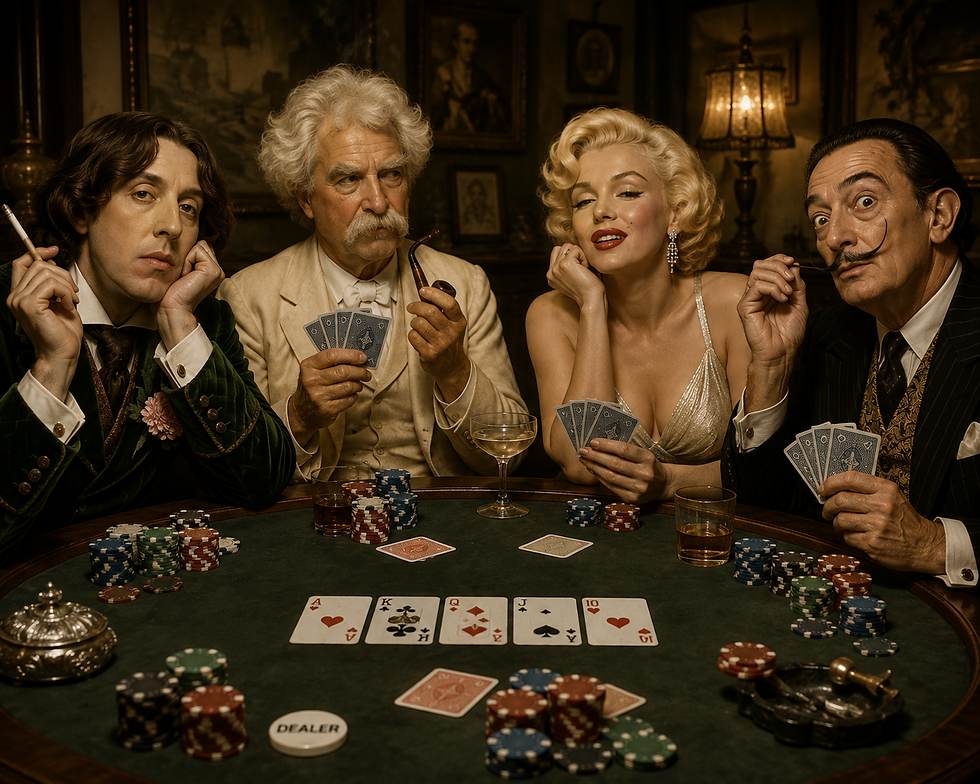
Wilde talks continuously, partly to distract the others and partly because silence seems an unreasonable waste of Oscar Wilde. Twain tells a story whose relationship with factual accuracy deteriorates heroically as it progresses. Dalí arrives late, dressed as though he has misunderstood both the game and the century, then plays every hand with such theatrical gravity that nobody can tell whether he has a royal flush or has simply discovered a particularly interesting chip. Monroe says very little. The men largely ignore this. That is their mistake.
Wilde attempts an extravagant bluff. Twain calls it. Dalí raises for reasons known only to Dalí. Monroe quietly raises again. One by one, they discover that she has the best hand.
Winner: Marilyn Monroe.
Wilde had spent years ensuring that everyone noticed him. Twain made an art of becoming the character people expected Mark Twain to be. Dalí practically turned self-promotion into a branch of surrealism. Monroe had the opposite problem: the world noticed her constantly and still frequently failed to see her. Behind the carefully manufactured image was a serious reader who built a substantial personal library, sought out challenging acting and literature, and spent much of her career frustrated by people who assumed the blonde on the screen represented the limits of the woman playing her. At a poker table, being underestimated is not an insult. It’s an asset. Wilde loses his chips but wins the conversation. Twain insists the hand happened differently. Dalí claims the cards are melting. Monroe takes the money.

When the Machines Learned to Bluff
For a long time, games offered reassuring evidence that human intelligence remained special. Computers could calculate faster, certainly, but chess required strategy, intuition and the ability to think several moves ahead. Then, in 1997, IBM's Deep Blue defeated world chess champion Garry Kasparov, and humanity quietly moved the goalposts.

Chess, we explained, was ultimately a game of perfect information. Both players could see every piece and every possible move. Of course a sufficiently powerful machine could eventually master it. Poker would be different.
And for a while, it was. Poker presents a computer with something chess does not: things it cannot know. Your opponent's cards are hidden. Their bet may represent strength, weakness, or an attempt to make you believe one while possessing the other. A successful player must make decisions under uncertainty, vary strategies so opponents can’t exploit predictable patterns, and sometimes deliberately behave deceptively. Yet computers learned this too. In 2017, an artificial intelligence called Libratus defeated four leading professional players in heads-up no-limit Texas Hold ’em.

Two years later, Pluribus defeated elite professionals in six-player games. We had taught machines not merely to calculate the cards, but to navigate incomplete information against humans trying to mislead them.
Thousands of years after people first began turning hidden cards into games of deception, we built machines sophisticated enough to join us. Poker had traveled from ancient card games to riverboats, saloons, casinos, television and the internet, accumulating rules and strategies along the way. Now the machine across the table could calculate probabilities without getting tired, frustrated, frightened, overconfident or emotionally attached to the money already in the pot. Humanity had finally created the ideal poker player. Unfortunately, we’d also taught it how to bluff.
THE TABLE, HAND SIX: THE LEADERS
The Players: Julius Caesar · Alexander the Great · Genghis Khan · Margaret Thatcher
Four people for whom backing down was rarely the preferred opening position. Caesar crossed the Rubicon when Roman law suggested rather strongly that he should not. Alexander conquered an empire stretching from Greece to India before reaching the awkward point at which his army became considerably less enthusiastic about continuing than he was. Genghis Khan transformed scattered Mongol tribes into an empire by demonstrating that resistance could have remarkably poor long-term prospects. Thatcher acquired the Iron Lady nickname and spent much of her career ensuring nobody considered it an exaggeration. Nobody at this table has arrived intending to fold.

Alexander attacks first. Caesar waits exactly long enough to make the attack look premature, then raises. Genghis raises both of them. Thatcher calls. The pattern continues. Alexander treats every pot as unexplored territory. Caesar accumulates chips methodically and begins behaving as though the table has always been part of Rome. Genghis loses one hand, stares at the player responsible, and creates the uncomfortable impression that he intends to return in spring with cavalry. Thatcher simply refuses to be moved.
Eventually Alexander pushes everything forward. Caesar calls. Genghis calls. Thatcher looks at the three men, then at her cards. She calls. Alexander has overextended. Caesar has mistaken confidence for security. Genghis has discovered the rare opponent who cannot be intimidated.
Thatcher has the winning hand.
Winner: Margaret Thatcher.
Alexander conquered until his own exhausted army finally refused to go farther. Caesar accumulated extraordinary power but discovered that being the most powerful man in Rome did not necessarily mean everyone in the room was on his side. Genghis Khan built the largest contiguous land empire in history largely by making surrender appear an increasingly attractive lifestyle choice. Thatcher spent eleven years governing Britain while acquiring a reputation for political combat so formidable that even members of her own party eventually concluded the only reliable way to stop her was to remove her themselves. Three men came to the table accustomed to making other people yield. They had the historical misfortune of sitting down with a woman who built an entire political identity around not doing so. Alexander wants to keep playing. Genghis wants his chips back. Caesar wants to know who betrayed him. Thatcher picks up her handbag and leaves.

The Cards We’re Dealt
In the end, poker survives for much the same reason people do. It asks us to make decisions without knowing everything we would very much like to know. We get a few cards, a little information, some questionable instincts and a collection of other people who are concealing things from us. Then somebody asks what we intend to do about it. There are no guarantees that the sensible choice will work, no refunds when it doesn’t, and very little sympathy available from the person collecting your chips.

Maybe that’s why the game has traveled so well. The rules have changed, the tables have changed, the stakes have changed, but uncertainty has remained remarkably popular. We tell ourselves that if we study hard enough, calculate carefully enough and watch everyone closely enough, eventually we’ll know what’s coming. We won’t. There is always one more card waiting to be turned. The plane still leaves. The phone rings. Someone walks through the door. Someone else walks out. Life has always had a rather casual attitude toward our plans.
The trick, then, may not be learning how to win every hand. Nobody does. It may be learning which hands are worth playing, when courage has quietly become stubbornness, when caution has become fear, and when the smartest thing a person can do is push back from the table and let somebody else discover what happens next. We admire the people who go all-in because they make better stories. History tends to remember the Alexanders. It’s considerably less diligent about recording all the sensible people who looked at what was happening and decided they had somewhere else to be. (seeya)
So, we play what we’re dealt. Sometimes brilliantly. Sometimes badly. Sometimes with a pair of sixes that P.T. Barnum has somehow persuaded us is a royal flush. We bluff, we calculate, we misread the room, we stay too long, we leave too early, and occasionally we make exactly the right decision and lose anyway. Then the cards are gathered, the table is cleared, and sooner or later someone deals again. Maybe that’s why poker has lasted. Not because it resembles life perfectly, but because it offers the comforting fiction that, for a little while at least, life fits neatly into fifty-two cards - and that somewhere among them, if we’re patient, lucky, or just convincing enough, there might still be one more good hand.
Authors Note: If all this has left you with the urge to gather a few friends around a table and begin questioning their honesty, judgment and ability to maintain a straight face, you’ll need some equipment.
Copag 1546 Black & Gold Playing Cards

If you’re going to lose money, you may as well do it with respectable cards. These Copag 1546s are poker-size, jumbo-index and made from 100% plastic, which makes them durable, washable and considerably better equipped to survive a long evening than some of the players. The black-and-gold design also lends the proceedings just enough dignity to suggest that what’s happening around your kitchen table is somehow more sophisticated than four adults lying to one another about pairs of sixes. — Get them here
Essential Poker Math, Expanded Edition by Alton Hardin

For those uncomfortable relying entirely on instinct, facial expressions and the conviction that surely the next card will be the one, Alton Hardin offers another approach: mathematics. Essential Poker Math breaks down the fundamental numbers behind No-Limit Hold ’em - the odds, probabilities and calculations that separate an informed decision from simply pushing chips forward and hoping history will be kind. While it won’t necessarily make the cards behave, it may help you understand better why they’re behaving badly. — Get it here
Automatic Card Shuffler

Finally, remove at least one opportunity for accusations of corruption. This rechargeable card shuffler handles one or two decks, offers automatic and manual modes, and charges by USB-C. Press the button, let the machine do the work, and nobody can blame the dealer for suspiciously favorable arrangements of the cards. Of course, they’ll still blame the dealer. But now you have plausible deniability. — Get it here
As always, any purchases made through these links help support the continued production of essays examining the thin and increasingly questionable line between human civilization and organized nonsense. It costs you nothing extra, and helps support Anyhigh - which, statistically speaking, is probably a better bet than that inside straight.


I think my favorite grouping was the last! I would bet on Margaret every time! Fearless in the face of overly confident men, who by the way in the their Own right controlled most of the known world!
And yet, I’d still pick Margaret over them all! Except maybe Marilyn Monroe, who existed to exist to frustrate stupid men, until……. One of them killed her (conspiracy theory for another time).