
The Riddles of Lifetimes

There are questions that have no business being asked, and yet humanity keeps asking them. Why is there something rather than nothing? Why do we pay extra for ripped jeans? Why does the remote control only vanish when there’s something on that we really want to watch? These curiosities haunt us, little riddles slipped into the pockets of daily life like unwelcome receipts.

Karl Marx once declared that the riddle of history was nothing less than mankind’s relentless struggle to liberate itself. Noble words, certainly - but even Marx might have admitted that history is less a riddle solved than a riddle repeated, the answer scribbled in the margins and ignored. Each generation takes a fresh crack at it, then quietly passes the puzzle on to the next, as though life itself were a Sphinx too polite to simply devour us and be done with it.
Of course, not all riddles drape themselves in philosophy or politics. Some arrive dressed in wordplay, standing at the crossroads between humor and humiliation. A riddle, strictly speaking, is nothing more than a question posed in a deliberately puzzling way, its answer hidden by misdirection, metaphor, or sheer silliness. It is the oldest party trick in the human repertoire, second maybe only to fire - and often just as likely to leave someone burned.

Which brings us here, to the matter at hand. Since life insists on presenting us with riddles of the cosmic and historical variety, we figured we’d take some time today to indulge in the lighter ones - the groan-worthy, grin-inducing specimens that remind us confusion can also be entertaining. So, consider this your guided tour through a small cabinet of riddling curiosities. A gallery equal parts laughter, eye-roll, and the enduring truth that the joke is, as always, on us.
The Museum of Confusion
Step quietly now because the marble floors carry sound and the docent has a hangover. Welcome to the Museum of Confusion, a place where curiosity is curated, and clarity is strictly prohibited.

What you’ll find here are not paintings or relics but riddles - those small, mischievous puzzles humans have been smuggling into conversation since before we had conversation. Each gallery offers a different angle on the ridiculous ways we amuse ourselves with questions that don’t really need answers. But we’re providing answers anyway. Just look for the corresponding number in the gift shop at the end of this post.
Gallery 1: The Ancient Wing
Our first stop: the old masters. Riddles are among the oldest forms of entertainment. Long before TikTok, ancient poets and philosophers distracted themselves/ with riddles. The Greeks gave us the Sphinx, who reduced the human condition to a parlor game.

And here, beneath glass, are some classics that might have circulated around smoky taverns or dusty amphitheaters.
The Sphinx guarded the entrance to the Greek city of Thebes, demanding all travelers answer a riddle correctly before they could pass. If they couldn’t come up with the right answer they’d be eaten. The legendary question is quite possibly the most famous riddle in history:
1A - "Which creature has one voice and yet becomes four-footed, and two-footed, and three-footed?"
An ancient Sumerian riddle traces its roots thousands of years back to the Middle East:
1B - “A house you enter blind but come out of with sight. What is it?”
Norse mythology offers many brilliant riddles. According to one, King Heidrek threatened to imprison Gestumblindi should he be unable to think up a riddle to stump his majesty.

The challenge resulted in this riddle:
1C - “Four hang, four sprang, two point the way, two to ward off dogs, one dangles after, always rather dirty. What am I?”
The point was never revelation but humiliation - the smug smirk of the riddler, the sheepish nod of the baffled. Some things never change. The ancients remind us that riddles were never just games – they were initiation rites, thresholds you crossed to prove you belonged on the other side.
Gallery 2: The Absurdist Collection
Here we arrive at the wing most often confused for a comedy club.

The absurdist riddle thrives on the pun, the groan, and, inevitably, irritation. It’s humor’s junk drawer - messy, inexplicable, but full of surprises. On display:
2A - “Why was six afraid of seven?”
2B – “Why don’t elephants use computers?”
2C – “What did the buffalo say to his son when he left for college?”
2D – “Why did the fish blush?”
2E – “Why do cows have hooves instead of toes?”
Like modern art, you’re not supposed to like them; you’re supposed to recognize them and mutter “fascinating”, as if that helps.
Gallery 3: The Trickster’s Hall
Proceed carefully, this gallery has been known to bite.
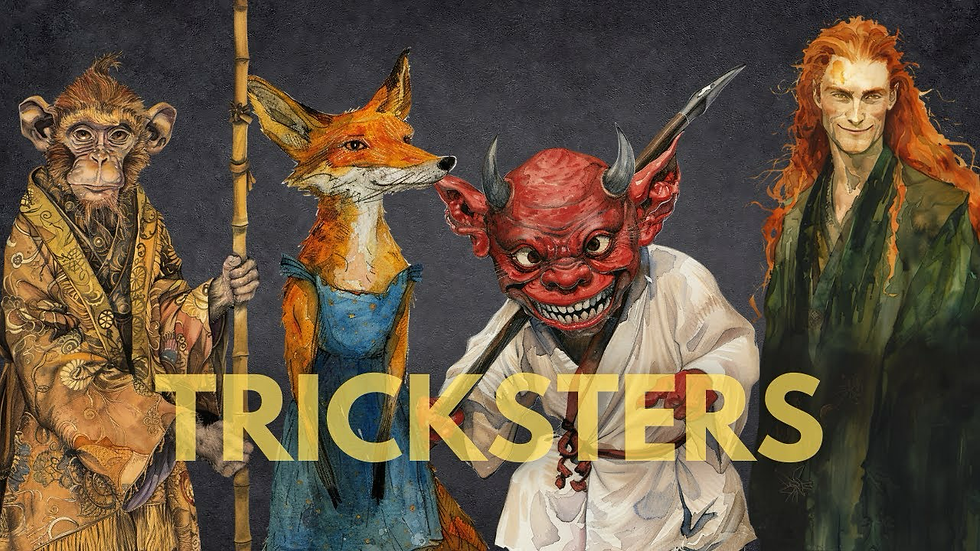
Trickster riddles thrive on smugness, dangling an answer right before your nose while you wander in circles, existing to trap the listener in plain sight. They’re the “gotcha” journalism of humor, gleefully exposing your inability to think sideways. Consider:
3A – “Men desire me in public but fear me in private. What am I?”
3B – “I’m brought to the table, cut and served but never eaten. What am I?”
3C - “How do you know that a vampire loves baseball?”
3D - “Why did the skeleton go to the party alone?”
3E – “Why do chickens avoid comedians?”
That’s the trickster’s power: to remind us that the simplest things become incomprehensible the moment someone asks us to explain them. The lesson being that certainty is a liability. The more convinced you are, the easier the trap to set.
Gallery 4: The Hall of Mirrors
And finally, we’ve reached the reflective chamber. Here riddles grow philosophical, bending logic until it stares back at you.

These are less jokes and more existential nudges, the kind of thing that makes you wonder if you haven’t actually been part of the exhibit all along. Examples:
4A - “What belongs to you, but others use more than you do?”
4B - “I have cities, but no houses; I have mountains, but no trees; I have water, but no fish. What am I?”
4C - “I’m always in front of you but can’t be seen. What am I?”
4D - “What goes up but never comes down?”
4E - “The more you take, the more you leave behind. What am I?”
There’s a sting in these simplicities, a reminder that our grand identities and civilizations are often no sturdier than metaphors with good timing.
Exit Through the Gift Shop
And there you have it, the tour completed, the riddles of lifetimes surveyed. You’ve solved the riddles or, more likely, been beaten by them, which puts you in the company of every drunkard, philosopher, and playground victim who’s ever had one lobbed at them. That’s the real trick of riddles - they’re democratic. They don’t care if you’re a king or a fool; the punchline still makes you look stupid. That little humiliation is the point.

The truth is riddles aren’t quaint artifacts. They’re alive. They show up in campaign slogans, corporate mission statements, and those smug ads that tell you “Guess what’s inside the box.” Politicians pitch them as policies, gurus dress them up as enlightenment, and you’re left nodding like a sucker because you don’t want to be the only one who doesn’t get it.
Like any museum, the real exhibit is not what you saw but what you carry home with you – in this case, maybe the sense that confusion itself is a heritage worth preserving. Riddles endure not because they need to but because we do. They console us with the possibility that life’s larger enigmas - history, politics, love, death - might also have answers hidden in plain sight. Or perhaps the answer is that there is no answer, only a smirk and a shrug.

So now, please exit through the gift shop where the answers await. Pick up your postcard of the Sphinx, maybe a novelty t-shirt that says, “I Got Stumped in the Hall of Mirrors.” But the real souvenir you’re taking is that itch in the back of your head: that suspicion that life is one long riddle with no neat answer. That the only real souvenirs available are more riddles.
The Gift Shop

Gallery 1 The Ancient Wing:
A) Man - who crawls on all fours as a baby, then walks on two feet as an adult, and then uses a walking stick in old age.
B) A school
C) A cow
Gallery 2 The Absurdist Collection:
A) Because seven eight nine.
B) They’re afraid of the mouse
C) Bison
D) Because it saw the ocean’s bottom
E) Because they lactose
Gallery 3 The Tricksters Hall:
A) The truth
B) Cards
C) Because he turns into a bat every night.
D) Because he had no body to go with him.
E) They don’t want to be roasted.
Gallery 4 The Hall of Mirrors:
A) Your name.
B) A map.
C) The future.
D) Your age.
E) Footsteps.


I can’t stand riddles, because I stink at them. I still don’t get gallery 1 C?????? Ugh…….
I definitely would have been eaten by the Sphinx……. “Can you give me a hint?” wouldn’t have helped. I would be Sphinx food