
On Bread & Children: Notes from a Sourdough Household

There’s a particular tone people adopt when they are discussing something that matters deeply, but not in a way that society has prepared language for. It’s careful. Earnest. Longing. Slightly apologetic. It shows up in long messages sent late at night, punctuated by timestamps and thumbs-up emojis, as though reassurance might be hiding in the margins. This tone is usually reserved for parenting, illness, or the management of small, unpredictable creatures that require frequent feeding and respond poorly to neglect.

In this case, the conversation unfolded not in a kitchen or a hospital waiting room, but inside a WhatsApp thread. Two adults, both otherwise sensible and reasonable, traded schedules, measurements, and gentle course corrections. Hours were counted. Intervals debated. Words like “weak,” “strong,” and “successful” were used with clinical restraint, as if optimism itself needed to be rationed. No one raised their voice. There was the occasional attempt at levity, if only to relieve the pressure of the moment.
What stood out was the intimacy of it. The quiet authority of professional experience on one side. The hopeful diligence of the newbie on the other. The question was asked: was he getting too far into the weeds? The answer, delivered kindly, suggested that yes, eventually, but not yet. First things first. Let’s focus on getting a rise. It was mentorship. It was caretaking. It was the careful supervision of something small, vulnerable, and entirely unpredictable. The sharing of love for a defenseless creature being nurtured into the world, largely through guesswork.
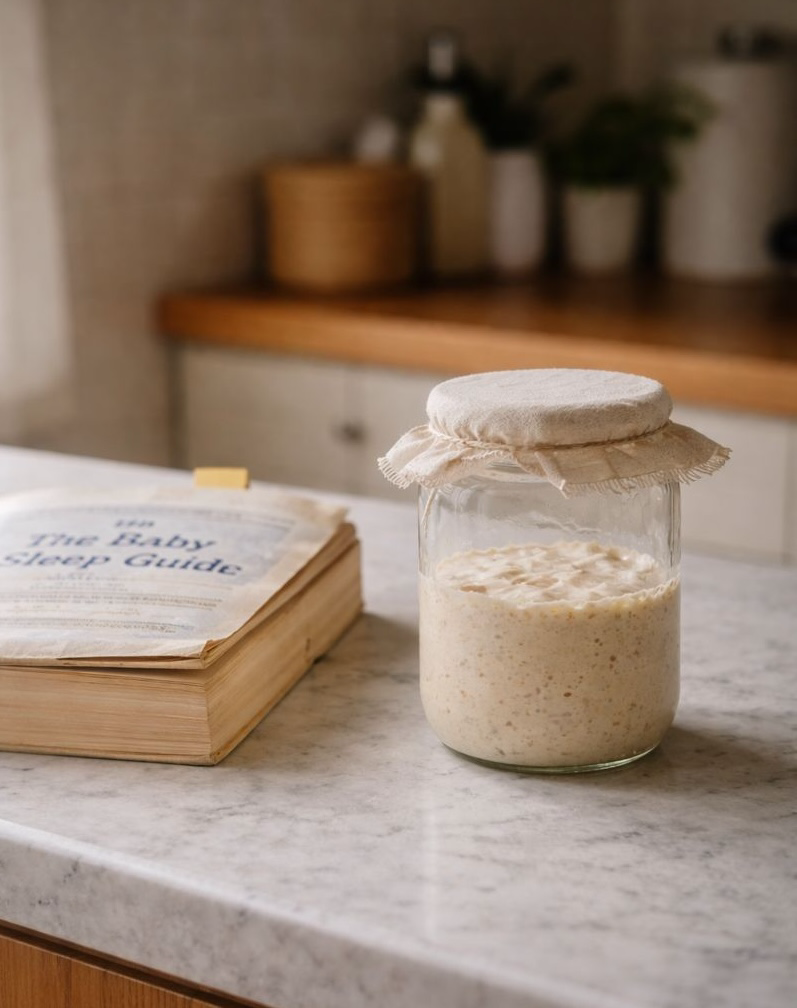
This seems like an appropriate time to mention that what the two were talking about was sourdough bread. Specifically, the pursuit of the perfect loaf. Or more accurately, the successful upbringing of a temperamental, semi-sentient mass of flour and water that must be fed on schedule, monitored for signs of weakness, and gently shaped without crushing its spirit. If this isn’t parenting 101, it is at least a convincing rehearsal. At this stage, everyone involved still believed the problem, if there was one at all, could be solved by following the instructions. They hadn’t yet learned that the process unfolds in recognizable phases, each less rational than the last.

Denial
Denial is the stage where nothing is technically wrong. The ingredients are correct. The instructions have been followed. The hydration is appropriate; the flour has sufficient protein. The starter, while perhaps not at its strongest, is active enough to justify optimism. It’s given a name. This is how attention quietly turns into attachment. Fermentation, everyone agrees, is not a fixed schedule but a range. Any concerns can be explained by variables: temperature, timing, humidity, the flour behaving differently this time. If the dough is slow to respond, it’s because it’s doing important work beneath the surface.

In the world of sourdough, denial often disguises itself as patience. The dough simply needs more time. Fermentation is a slow art. Thirty-five hours may sound excessive, but it’s not unheard of. Good things, everyone agrees, cannot be rushed. If the loaf fails to rise, it’s not failure so much as character development. One learns, early on, to distrust panic and to favor restraint. The dough, after all, can sense fear.
This is also the phase where reassurance becomes technical. A loaf that spreads instead of rising is described as “over-relaxed.” A starter that struggles is said to be “recovering.”

Weakness is reframed as transition. Every irregularity has a plausible explanation, preferably one involving ambient conditions rather than personal error. The process is trusted. The method is sound. The variables are external.
Parents will recognize this logic immediately. Growth charts are interpreted generously.

Timelines are widened. Advice is filtered through the comforting phrase “that’s still normal.” Nothing is wrong yet. There is still time to correct course without calling it correction. At this point, denial is not a refusal to see the truth. It’s an act of love, designed to keep everyone calm until it becomes absolutely necessary not to be.
Anger
Anger begins when patience stops feeling virtuous and starts feeling naïve. The same variables that once explained everything now explain nothing. Temperature becomes an adversary. Humidity turns hostile. Every source disagrees. One method insists the starter is weak. Another claims it’s too strong. The loaf spreads because it was under proofed. No, over proofed. No, shaped incorrectly. No, not shaped firmly enough. The flour, previously “reliable,” is suddenly suspect. Someone, somewhere, is lying about protein percentages.

In sourdough, anger often presents as intervention. Feeding schedules are tightened. Ratios are adjusted. The starter is scrutinized with new suspicion, its bubbles are judged insufficient, its aroma questionable. Terms like “acid load” and “over-fermentation” enter the conversation, not as observations but as accusations. The dough is no longer developing. It’s misbehaving and clearly knows it. The baker’s calm suggestions are received politely, then quietly second-guessed at two in the morning.

In parenting, what makes this stage particularly exhausting is the effort. Nothing has been abandoned. In fact, everything is being done more carefully than before. Schedules are enforced. Inputs are controlled. Attention is constant. And yet the results remain stubbornly indifferent. The frustration is not that the process has failed, but that it continues to demand faith while offering no reassurance in return.
Bargaining
Bargaining begins with the comforting belief that nothing fundamental is wrong.

The problem, clearly, is calibration. Somewhere between feeding intervals, hydration percentages, and ambient temperature lies the version of reality where everything works. One simply has to locate it.
In sourdough, this manifests as tinkering. Flour is swapped, then blended, then briefly replaced with rye, as if introducing a different temperament might help. Hydration is nudged up, then back down. Timelines are rewritten. The dough is no longer following a plan so much as participating in a series of experiments designed to make it feel understood.
This is also when the starter becomes a dependent. Feeding ratios are adjusted with surgical optimism. Progress is checked, compulsively. Miss one window and anxiety spikes. The jar is opened, inspected, encouraged. It begins to resemble a Tamagotchi for adults: a small, needy organism whose continued well-being feels directly proportional to the amount of attention paid to it.

The more unpredictable it becomes, the more closely it’s monitored.
In parenting, this stage is painfully familiar. It’s when routines are revised, techniques borrowed, and advice stitched together into something bespoke and untested. What worked for someone else is adapted with hope and disclaimers. The belief is not that perfection is possible, only that diligence will be rewarded. If enough care is applied, if the right balance is struck, the child, as with the dough, will surely meet you halfway.
Depression
Depression arrives without drama. There is no single failure to point to, no decisive mistake. The process simply stops responding the way it once promised it would. Adjustments slow. Notes are no longer kept as carefully. The dough is fed, but without optimism. It is checked, but not with hope.

In sourdough, this is when the goal quietly changes. A dramatic oven spring would be nice, but a modest rise will do. An open crumb is no longer discussed. Structure becomes the ambition. Flavor, at least, is dependable if not exciting. The loaf may be dense, but it is edible. This is said out loud, as reassurance, and accepted.
The starter remains alive, which feels like an accomplishment. It bubbles eventually, doubles sometimes. It smells fine, or fine enough. The process continues, but the urgency is gone. What was once exciting now feels procedural. Care persists, though the belief that it will be rewarded has thinned.
In parenting, this stage is less about disappointment than fatigue.

It’s the moment when ideals are replaced with endurance, and success is measured quietly, in smaller units. Did everyone make it through the day? Was anyone harmed? Was something learned, even accidentally? Depression is not the absence of love. It’s love continuing, but on reduced expectations.
Acceptance
Acceptance is not the moment everything suddenly works. The loaf does not emerge flawless, nor does the process finally reveal its secrets. What changes instead is the relationship to outcome. The dough is no longer expected to perform. It is allowed to be what it is.

In sourdough, acceptance looks like trust. Feedings return to a sustainable rhythm. The starter is no longer hovered over but checked in on. Timelines loosen. The dough is shaped with care, but without force, and placed gently into the oven with expectations that have been, at last, appropriately calibrated.
This is also when the humor returns. The starter’s moods are discussed with affectionate resignation. Its preferences are respected. Missed feedings are forgiven or at least explained. A loaf that would once have prompted analysis is now sliced, buttered, and eaten without commentary. The bread may not be perfect, but it is recognizably yours.
In parenting, acceptance arrives the same way. Not as surrender, but as clarity.

The realization that raising something well does not require mastery, only presence. That guidance matters, but control was always something of an illusion. The child, like the dough, will become itself regardless. Your role is not to engineer the outcome, but to stay involved long enough to encourage and witness it.
Bread & Children & Notes from a Sourdough Household
By the time the loaf is cooling on the counter, it becomes clear that the bread was never really the point. The starter still sits nearby, breathing quietly in its jar, bearing the same name it was given back when optimism was high and outcomes felt negotiable. It’s survived your interventions, your neglect, your confidence, and your doubt. But it’s warm, it’s real, and carries the unmistakable imprint of having been cared for by someone who tried. And, like any growing thing, it has become itself in spite of your efforts, not because of them.

There is a relief in this moment that has nothing to do with success. It’s the relief of participation. Of having stayed in the room. Raising a sourdough starter turns out to be an efficient way to rehearse parenthood without the hospital paperwork. You feed it on faith. You worry when it’s quiet and get exasperated when it’s making noise. You overreact to harmless phases and miss genuine signals of distress. You learn, slowly, that constant monitoring does not equal good care, and that growth happens on its own schedule, often at night, often when you’ve stopped checking.
At some point, you stop trying to optimize it. You accept that it will have moods, that it will sometimes disappoint you, and that no amount of online advice will fully account for its particular temperament. The same adjustments apply elsewhere. Children, like starters, do not improve when hovered over. They respond better to consistency than control, to presence more than precision. They require guidance and patience, yes, but they also require space to become unrecognizable from the plans you made for them.

So, the bread is sliced. The starter is fed, or not, and returned to the counter where it belongs. Tomorrow it will demand attention again, and you will give it what you can. This is not mastery. It’s participation. It’s the quiet success of having made something imperfect and alive, and of staying involved without insisting on authorship. In the end, whether you’re raising a little bread or a little person, the lesson is the same: you don’t make them who they are. You just help keep them alive long enough to find out.



OmG, it is so bizarre that you are writing about this topic as all 3 of my daughters and normally level headed wife have been obsessing about this crazy nutty pastime, hobby etc.
Giving “birth” to the right mixture is like losing your mind when your team loses (still unhappy about the Ram losing, but I digress). A lot of rage and frustration and rather than go to Trader Joe’s for one of their delicious premade sourdough loaves, they start all over again until that perfect mixture of ingredients timing and a little luck, it happens and then the real effort begins. The 2 am feedings and measuring and rolling and begging begins! If that all works out …
So funny!
So true.